Fair Lawn housing stock
Fair Lawn was built out almost entirely during the postwar expansion. The dominant home types are the split-level (the borough has one of the densest concentrations of split-levels in Bergen County), the mid-century ranch with attached garage, and the 1950s and 1960s tract single — compact one-and-a-half-bath houses on modest lots, drawn from a small set of builder plans repeated across whole neighborhoods. A smaller share of the stock is earlier postwar capes and a thin layer of pre-war housing closer to the older corridors.
These homes were built around 1950s family expectations: a single-cook galley or L-shape kitchen separated from a formal dining room, a shared family bathroom upstairs, and a half-bath off the entry. Renovations in Fair Lawn almost always involve modernizing those original layouts — opening galley kitchens to the family room, reclaiming pantry storage that the original plan never included, and upgrading the shared family bath into something closer to current expectations without rebuilding the home.
Kitchen design considerations for Fair Lawn homes
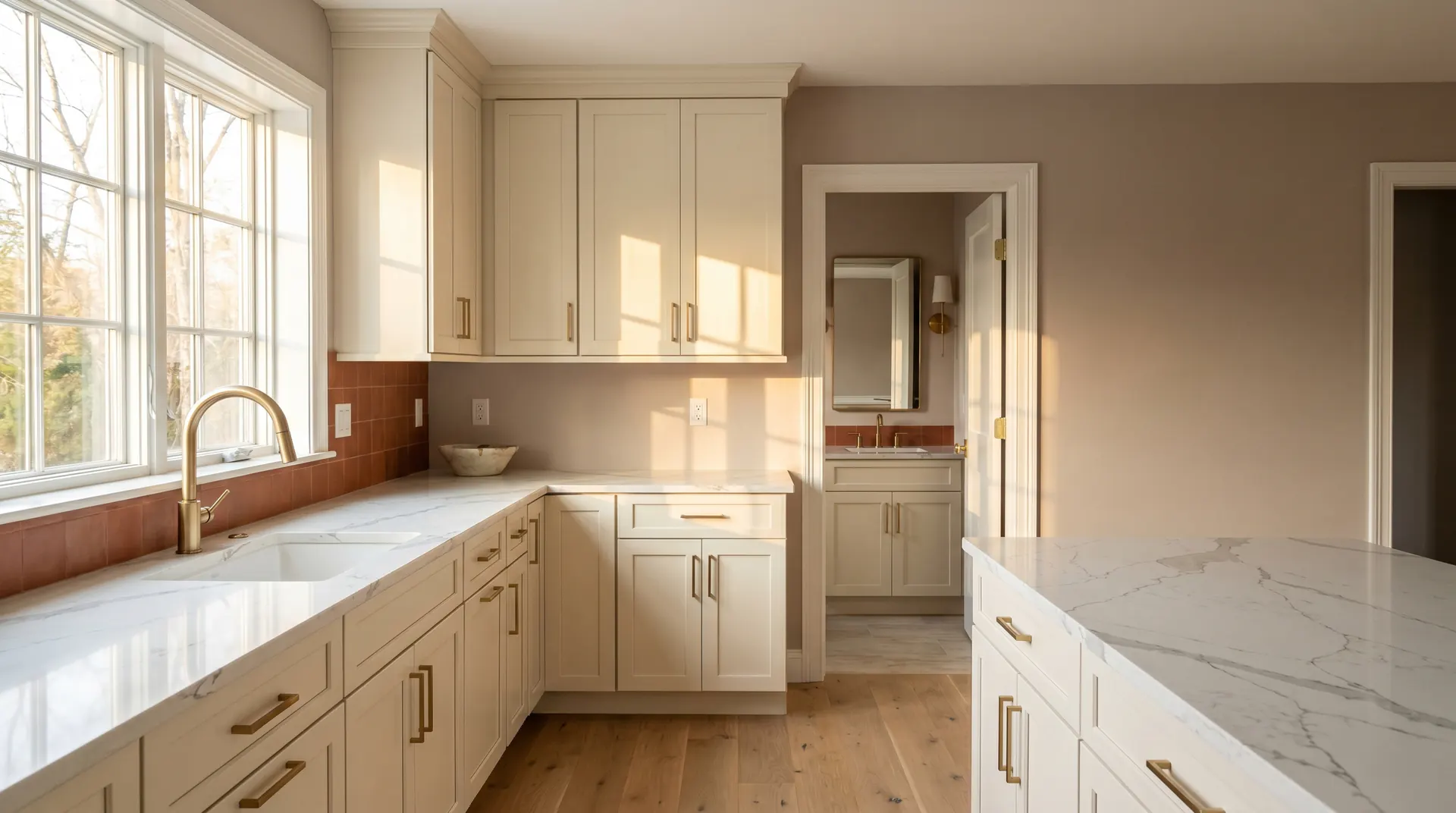
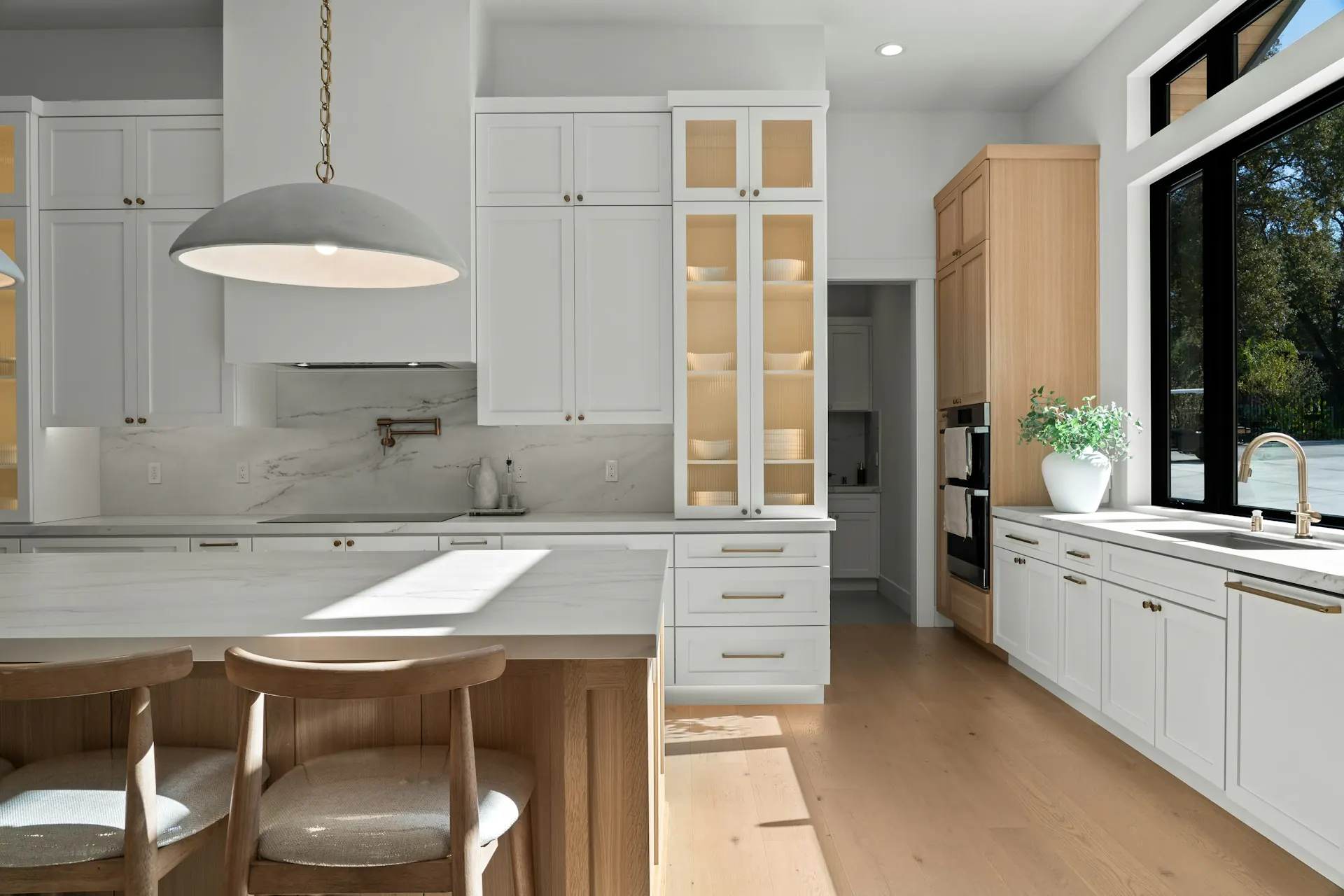
Kitchens in Fair Lawn split-levels and ranches are usually compact and frequently galley or narrow L-shape. The strongest cabinet direction is painted Shaker in white, cream, or warm neutral — the style is era-appropriate, ages well, and reads cleanly against the modest scale of the rooms. Framed cabinet construction is the right choice over frameless: the original drywall is often out of square, ceiling heights vary, and framed cabinets tolerate those conditions where frameless installations expose every imperfection.
The recurring layout question in Fair Lawn kitchens is whether to keep the galley footprint or open it up. Many original split-level kitchens are walled off from an adjacent family room or dining area; removing that wall (with appropriate structural review) and adding a peninsula or a small island transforms how the room functions for current households. The trade-off is cost and project length — a wall-removal renovation runs full-program scope while a refresh-scope keeps walls in place. Both are valid; the decision depends on whether the existing layout actively works against daily use.
Storage strategy is where Fair Lawn kitchens earn the most daily value. Original 1950s plans rarely included a pantry, dedicated baking storage, or deep drawers under cooktops — all of which are common upgrades in current renovations. Pull-out pantries built into 12-inch cabinet runs, deep drawers under ranges and cooktops for pots, vertical dividers for trays and cutting boards, and pull-out waste consistently return strong daily value in this stock.
Bathroom design considerations for Fair Lawn homes
Shared family bathrooms in Fair Lawn split-levels and ranches typically run 5 by 8 to 6 by 9 — compact rooms with the toilet, vanity, and tub-shower aligned along one or two walls. The most common upgrade is a refresh-scope renovation: replacing the vanity (usually with a 36 to 48-inch single in painted Shaker or transitional slab), updating the tub-shower with new tile and fixtures, replacing the floor with porcelain in a warm neutral, and modernizing the lighting and ventilation.
Primary bath additions and upgrades are increasingly common in Fair Lawn as households convert an adjacent room into a primary bathroom or expand into roof or attic space. These typically support 60-inch double vanities, walk-in showers with frameless glass, and a soaking tub when the footprint allows. Heated floors are worth budgeting for in primary baths here — Bergen County winters and the modest insulation in 1950s and 1960s housing make the comfort difference real.
Tile direction in Fair Lawn bathrooms typically stays disciplined: large-format porcelain wall tile in warm whites or soft grays, classic 3x6 subway as a wainscot or shower wall, mosaic floors in the shower, and porcelain floor tile in a warm neutral. Marble-look porcelain reads beautifully without the maintenance footprint of natural marble — a strong direction for primary baths in this stock.
Common project patterns in Fair Lawn
Three project patterns recur in Fair Lawn kitchen and bathroom work. The first is a galley-opening kitchen renovation in a split-level — removing the wall to the family room, adding a peninsula or small island, and replacing original cabinetry with painted Shaker. The second is a refresh-scope kitchen renovation that keeps walls and plumbing in place: new painted Shaker cabinets, quartz counters, classic subway backsplash, and updated lighting. The third is a primary bathroom addition or expansion — converting an adjacent room or expanding into attic space to add a 60-inch double vanity, walk-in shower, and heated floor.
Refresh-scope projects dominate the borough by volume because the 1950s and 1960s housing rewards careful modernization more than full structural rebuild. Storage upgrades, cabinet replacement, vanity replacement, and tile updates consistently return strong daily value at a fraction of full-program cost. The household plans an investment that improves daily life over the next 10 to 15 years rather than rebuilding the home.
The showroom path for Fair Lawn projects
When the project direction is clear — home type identified (split-level, ranch, postwar single), refresh scope or galley-opening decided, cabinet style narrowed, vanity sizing settled, tile palette directed — the next step is product selection in person. The Anve Kitchen and Bath showroom in Paramus is centrally located for Fair Lawn projects, with cabinet lines, vanity programs (including a 2-week local custom build for non-standard wall lengths), tile, and fixtures from the lines covered across this site. The conversation in person turns "painted Shaker in a Fair Lawn split-level kitchen" into a specific cabinet line, finish, and price; the same exercise pins down counter slabs, tile selection, and hardware.
| Home type | Cabinet style | Common finish direction |
|---|---|---|
| Postwar split-level (1950s–1960s) | Painted Shaker (framed) | Painted white, cream, or warm neutral |
| Mid-century ranch (1950s–1960s) | Painted Shaker (framed) | Painted soft warm gray, cream, or sealed white oak |
| Postwar tract single (1950s) | Painted Shaker (framed) | Painted white or warm neutral |
| Postwar cape (late 1940s) | Painted Shaker or beaded inset | Painted cream or soft warm gray |
| Renovated transitional (post-2000) | Painted Shaker or rift-cut white oak slab | Painted soft white or sealed white oak |
Fair Lawn borough context
Fair Lawn is a primary-residence community where households typically plan renovations for 10 to 15 years of daily use. The borough's family character and stable tenure shift the cost-vs-quality calculus toward durable, sensible choices: painted Shaker over peak-trend slab, classic 3x6 subway over shifting tile patterns, quartz counters over high-maintenance natural stone. The renovation pattern leans toward modernizing the postwar bones rather than rebuilding the home into something it was never designed to be. Resale balance matters because Fair Lawn's buyer pool is consistent — the next family looking at the home is likely to share the same priorities the current owners had. A renovation that respects the postwar character of the home — opens the galley intelligently, modernizes the family bathroom without overreaching, adds storage where the original plan was thin — reads as a thoughtful renovation. One that strips the home into a generic contemporary read often misses what the buyer pool is actually drawn to.
Common questions
-
What kitchen cabinet style works best in a Fair Lawn split-level?
Painted Shaker in white, cream, or warm neutral is the most reliable direction in Fair Lawn split-levels and ranches — the style is era-appropriate, ages well, and reads cleanly against the modest scale of the rooms. Framed cabinet construction is the right choice over frameless: the original drywall is often out of square, ceiling heights vary, and framed cabinets tolerate those conditions where frameless installations expose every imperfection.
-
Should I open up the galley kitchen in my Fair Lawn split-level?
It depends on whether the existing layout actively works against daily use. Many original Fair Lawn split-level kitchens are walled off from a family room or dining area; removing that wall (with appropriate structural review) and adding a peninsula or small island transforms how the room functions. The trade-off is that wall-removal renovations run full-program scope while refresh-scope projects keep walls in place. Both are valid; the household timeline and budget usually drive the decision more than aesthetic preference.
-
What storage upgrades return the most daily value in a Fair Lawn kitchen?
Original 1950s and 1960s Fair Lawn plans rarely included a pantry, dedicated baking storage, or deep drawers under cooktops. Pull-out pantries built into 12-inch cabinet runs, deep drawers under ranges and cooktops for pots, vertical dividers for trays and cutting boards, and pull-out waste consistently return strong daily value. Tall cabinets to the ceiling rather than stopping at 30 or 36 inches with a soffit gap reclaim meaningful storage volume.
-
How do I plan a primary bath addition in a Fair Lawn split-level?
Most Fair Lawn primary bath additions either convert an adjacent room or expand into roof or attic space. The resulting room typically supports a 60-inch double vanity, a walk-in shower with frameless glass, and a soaking tub when the footprint allows. Heated floors are worth budgeting for in primary baths here — Bergen County winters and the modest insulation in 1950s and 1960s housing make the comfort difference real.
-
What vanity size works in a Fair Lawn shared family bathroom?
Shared family bathrooms in Fair Lawn split-levels and ranches typically run 5 by 8 to 6 by 9 feet. The right vanity is usually a 36 to 48-inch single in painted Shaker or transitional slab — wider singles with one large mirror almost always outperform forced-fit doubles in this footprint. A wide single counter with thoughtful storage below typically functions better for family use than two cramped sinks.