Cabinet styles overview
Kitchen cabinets come in a small number of door styles that have stayed visually durable across decades, and a larger number of trend-driven variations. The four reliable starting points are Shaker, slab (flat-panel), inset, and raised panel. Each one signals a different home era and a different level of maintenance.
Shaker remains the default recommendation for most Bergen County homes because it reads cleanly in colonials, ranches, and renovated singles alike. Slab doors push the room toward a more contemporary read; inset is associated with historic and high-end traditional homes; raised panel is rooted in traditional architecture and is usually the wrong choice for transitional renovations.
Framed vs frameless
Framed cabinets have a face frame attached to the front of the box; frameless cabinets (sometimes called Euro-style) skip the frame and use the box edge directly. Framed cabinets feel slightly more traditional and tolerate older drywall and out-of-square walls better. Frameless cabinets give marginally more interior storage volume and a cleaner contemporary look but are less forgiving of rough installation conditions. Both can host any door style; the construction choice is independent of the visual style.
Door styles
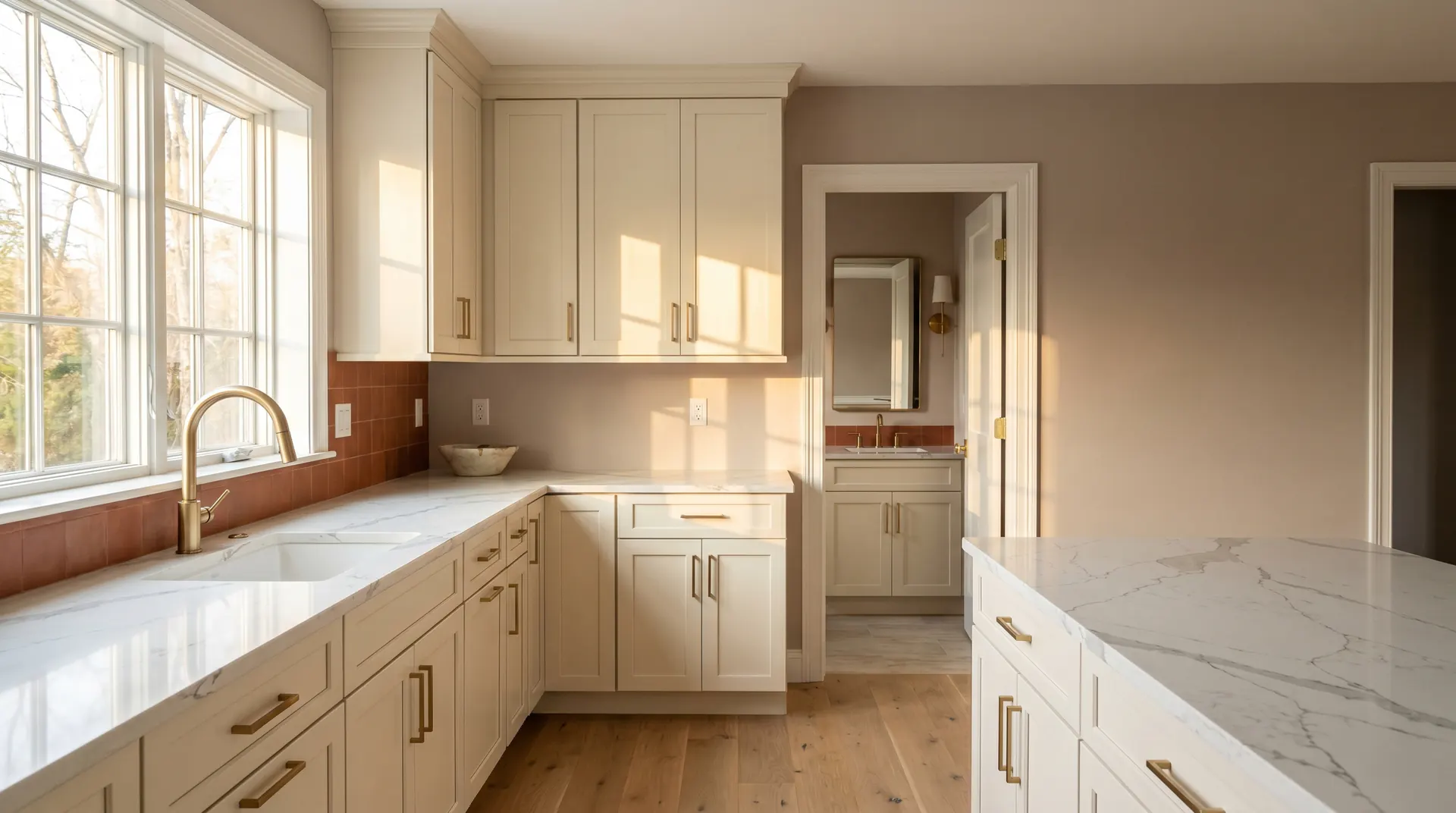
Shaker doors are recessed-panel doors with simple square stiles and rails. They suit nearly every Paramus home and tolerate both painted and stained finishes well.
Slab doors are flat with no detail. They read modern and minimalist, photograph well, but show every dust mote and fingerprint, especially in matte or dark finishes.
Inset doors sit flush within the cabinet face frame. They look custom and timeless, demand precise installation, and price near the top of the cabinet market.
Raised-panel doors have a center field that is raised relative to the frame. They suit classical traditional homes; in transitional renovations they tend to look heavy and date the room faster.
Beaded inset and rift-cut white oak slab are common transitional crossover choices for homeowners who want the historic feel without the maintenance footprint of true period cabinetry.
Finishes
Painted finishes give consistent color but show chipping at heavily used corners over time. Stained finishes show wear less and let the wood grain carry the look — white oak, walnut, rift-cut oak, and cherry each have their own character. Natural wood finishes feel warm and have come back into favor in the last several years. For families with high daily use, stained or sealed natural wood finishes are forgiving; high-gloss painted lacquer finishes are visually striking and the least forgiving of any cabinet finish.
Storage accessories
Storage accessories are not cosmetic — they decide whether the kitchen functions better than it did before. Useful additions include deep drawers under cooktops for pots, vertical dividers for trays and cutting boards, pull-out waste and recycling, mixer lifts in baking zones, and pantry pull-outs in dedicated pantry cabinets.
A common mistake is loading every cabinet with accessories. The better move is making a list of the storage problems the current kitchen actually has, then targeting accessories at those specific problems. Anything beyond that adds cost without function.
Measuring and planning
Cabinet planning starts from accurate measurements of wall lengths, ceiling height, window sill heights, door positions, and obstructions (vents, electrical panels, plumbing). Standard cabinet heights, depths, and widths assume a flat, square room — older Bergen County homes rarely are. Filler strips and scribe pieces handle out-of-square walls but should be planned, not improvised. Bring measurements (and photos of every wall) to the showroom; it removes guesswork and shortens the design phase.
Showroom checklist
A productive cabinet showroom visit usually covers: door style direction (1–2 options to compare physically), framed vs frameless preference, finish and color short-list, storage accessories needed, hardware direction (knobs, pulls, finish), and any non-negotiable storage problems to solve.
Bring rough measurements, a photo of every wall in the existing kitchen, and any inspiration images that capture the direction you are aiming for. Walking in with this set typically cuts design iterations in half.
Local context
Across Paramus and Bergen County, the most common cabinet directions are painted Shaker (cream, white, soft gray, or muted blue-green), rift-cut white oak slab in transitional homes, and inset cabinetry in historic singles. Painted dark cabinets (charcoal, deep green, navy) read strong but date faster than neutral painted Shaker — fine on accent islands or pantry walls; riskier as the entire kitchen. Resale balance is real in this market, and timeless usually outperforms trendy on the sales side.
| Door style | Best fit by home era | Maintenance footprint |
|---|---|---|
| Shaker | All eras — colonial, ranch, transitional, renovated singles | Low. Refinishable. Painted shows chipping at corners over time; touch-up friendly. |
| Slab / flat-panel | Modern and contemporary renovations | Low cleaning. Dust and fingerprints visible on matte and dark finishes. No detail to trap grime. |
| Inset | Historic and high-end traditional homes | Higher. Demands precise installation; seasonal wood movement may need adjustment. Premium price. |
| Raised panel | Traditional and classical homes | Higher. Detail traps dust and grease; cleaning takes longer than flat doors. |
| Beaded inset | Transitional homes wanting historic detail | Mid. More cleaning than Shaker, less than full traditional raised panel. |
| Rift-cut white oak slab | Transitional and modern Bergen County renovations | Mid. Sealed periodically. Grain hides minor wear; finish behavior matters. |
| Two-tone (island accent) | Any era — used as accent only | Same as the chosen door style. Color contrast can date faster than the door style itself. |
Bergen County cabinet considerations
Older Bergen County homes — Tenafly colonials, Glen Rock center-halls, Hackensack pre-war singles — frequently have ceiling height variations, out-of-square walls, and tight room dimensions that drive cabinet decisions as much as aesthetics do. Stock cabinet lines work for many of these rooms when planned carefully; semi-custom and custom lines earn their cost when the room geometry demands it. The right answer is room-specific, not brand-specific.
Service area
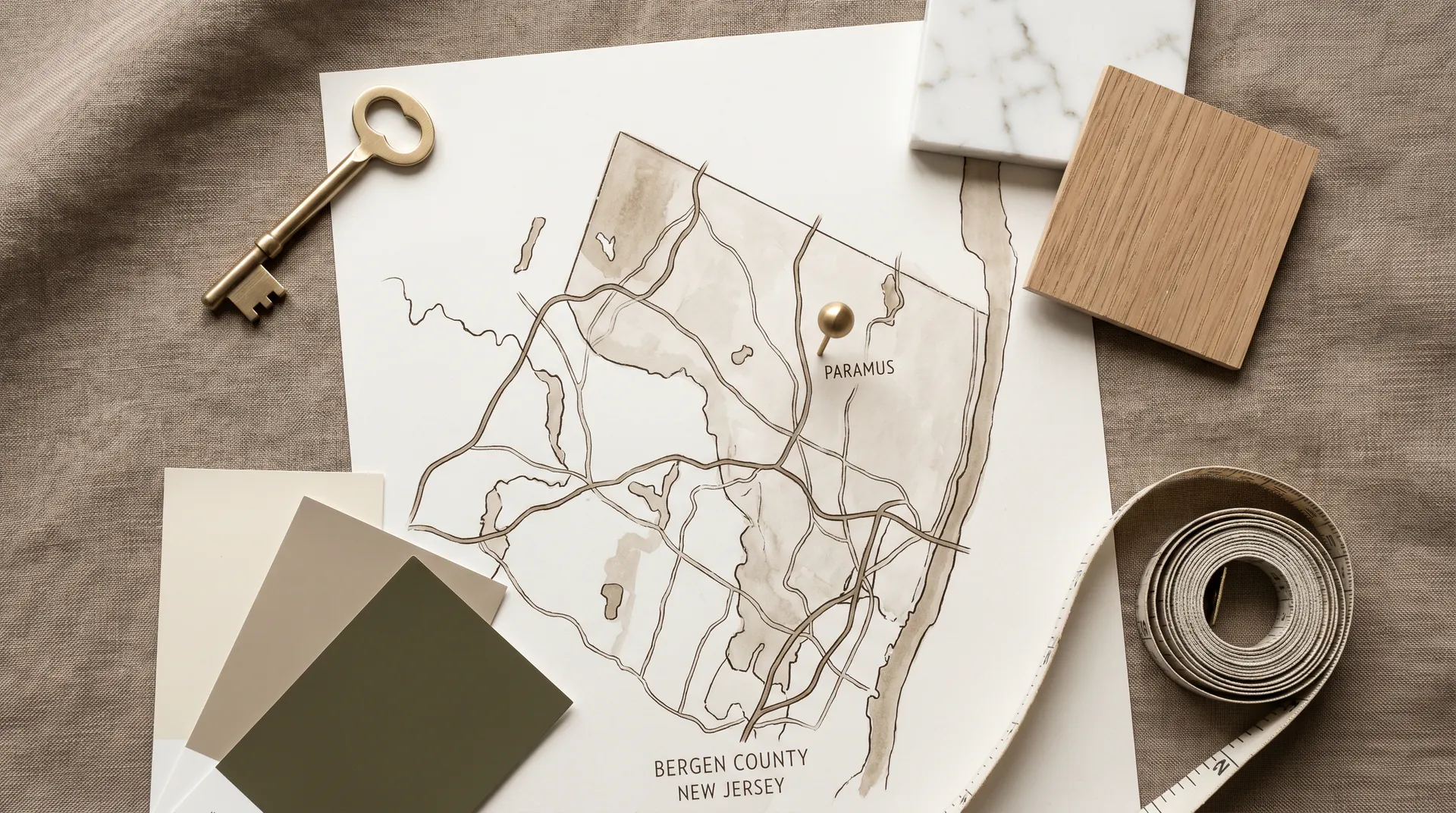
We help homeowners plan kitchen and bathroom projects across Paramus, Ridgewood, Fair Lawn, Hackensack, Oradell, and River Edge, and the wider Northern New Jersey region.
Common questions
-
What is the difference between framed and frameless cabinets?
Framed cabinets have a face frame attached to the front of the box; frameless cabinets skip the frame and use the box edge directly. Framed cabinets feel slightly more traditional and tolerate older drywall and out-of-square walls better. Frameless cabinets give marginally more interior storage volume and a cleaner contemporary look but are less forgiving of rough installation conditions.
-
Are painted cabinets durable for a family kitchen?
Painted cabinet finishes give consistent color and look beautiful at install but show chipping at heavily used corners over time. Touch-up is straightforward when the finish is well-documented, and quality painted finishes hold up well in family kitchens. For households with very high daily use, sealed natural wood finishes are slightly more forgiving of wear.
-
How long does a custom kitchen cabinet order take?
Stock cabinet lines usually arrive in two to four weeks. Semi-custom lines typically run six to ten weeks. Fully custom cabinetry runs longer — often twelve weeks or more depending on the shop and the program — and demands tighter coordination with the contractor schedule. Lead times shift seasonally; ask the showroom for a current estimate when planning your project timeline.
-
Should I match cabinet hardware to faucets?
Coordination is the goal, not literal matching. Brushed brass cabinet pulls usually read well alongside brushed brass faucets; matte black hardware can pair with matte black or unlacquered brass faucets. Mixing finishes is fine when done deliberately — a single accent finish (such as brushed brass) repeated across pulls, faucets, and lighting carries the room together.