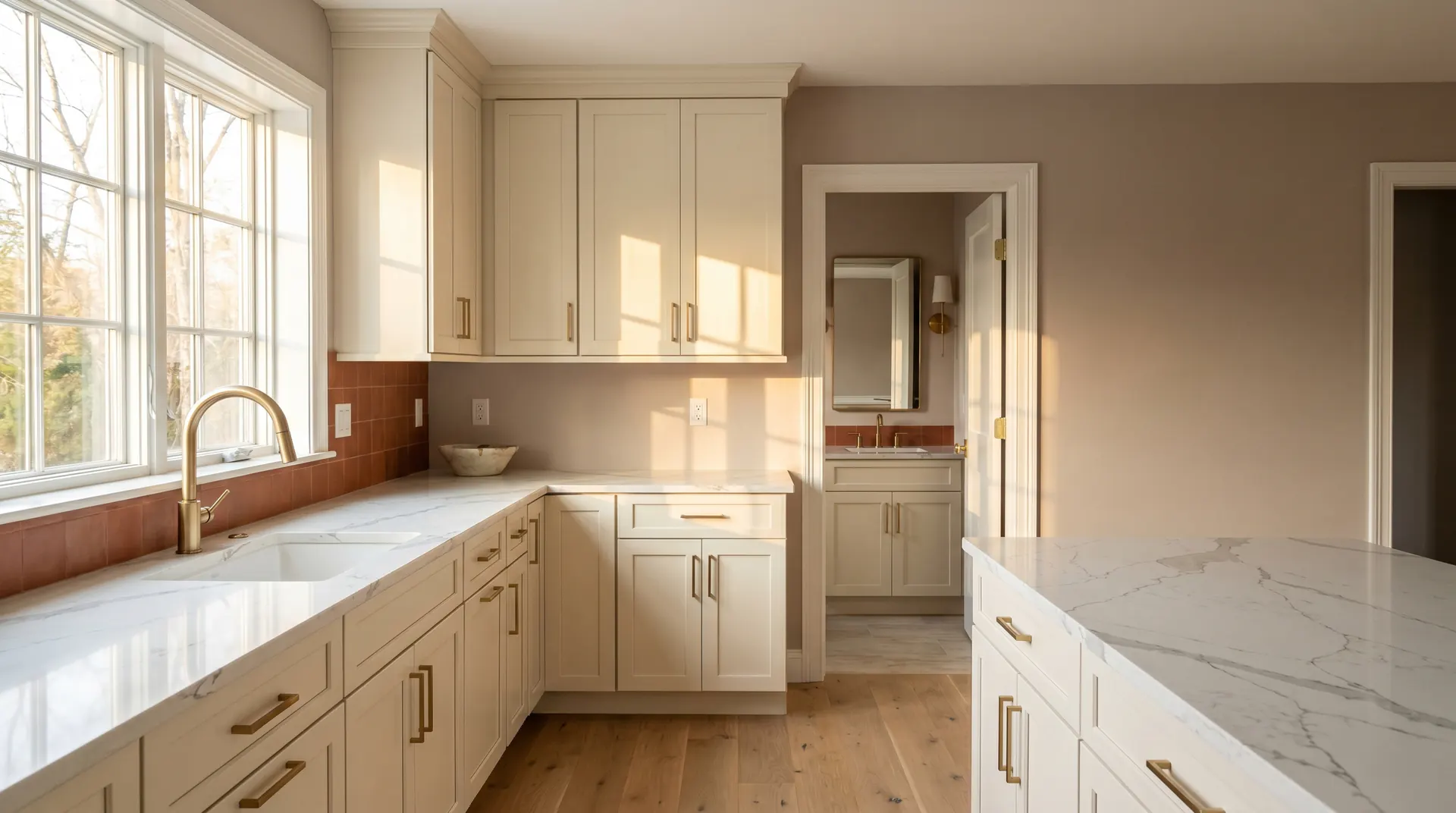
Five patterns are reshaping how Bergen County homeowners plan kitchen and bathroom renovations in 2026: refresh-scope is gaining ground in pre-1970 housing stock, primary baths are increasingly dropping the tub for a walk-in shower, custom 2-week vanity programs are pulling demand back from semi-custom catalogs, quartz is holding bathroom counter dominance with a marble revival in premium primary baths, and the recommended Bergen County contingency for full-program renovations has migrated from 10 percent to a 12–15 percent range. Each pattern is grounded in 2024–2025 industry data — primarily Sweeten’s New Jersey cost guides and the 2025 U.S. Houzz Kitchen and Bathroom Trends Studies — and interpreted through what the editorial team reads in Paramus and Bergen County planning conversations. The framing is editorial: industry data on one side, local pattern reading on the other.
How to read these observations
This piece is a reading of two things at once. On one side: 2024–2025 industry data points published by Sweeten and Houzz, both of which run reliable methodology against large samples. On the other: the Bergen County housing stock specifically — Hackensack pre-war singles, Fair Lawn split-levels, Paramus postwar singles, Tenafly and Englewood center-hall colonials, Ridgewood and Glen Rock traditionals, and the renovated transitional homes spread across Westwood, Hillsdale, Oradell, River Edge, and the rest of the river-corridor towns — and the planning conversations that happen in those homes.
The framing matters because national or even state-level data does not always read cleanly into a Bergen County primary bath. New Jersey averages flatten the difference between a Newark refresh and a Tenafly full-program. Bergen County labor and material premiums run 15 to 25 percent above national medians, and the housing stock distribution is older and more varied than the state average suggests. So each pattern below pairs the industry data point with the local read — what the data suggests at the national or state level, and what the same direction looks like when it lands in a 1925 Hackensack pre-war or a 1962 Fair Lawn split-level.
The five patterns are not in any particular order of importance. They are listed in the order that helps a homeowner think about a 2026 renovation: scope first, layout second, vanity program third, surface direction fourth, and contingency last.
Pattern 1 — Refresh-scope gains in pre-1970 housing stock
Refresh-scope kitchen renovations are gaining ground in Bergen County pre-1970 homes because the industry cost gap between budget and full-program has widened, and because the hidden-conditions risk in older housing makes the full-program path harder to underwrite. Sweeten’s New Jersey kitchen guide reports budget-tier full renovations starting around $28,000, mid-tier programs starting around $81,000, and high-end programs starting around $170,000 before any custom or structural scope. The 2025 Houzz Kitchen Trends Study places the 2024 national kitchen median at roughly $60,000, with the 90th percentile of major remodels at $180,000 or more. The spread between a budget tier and a full-program tier has widened across the last two reporting cycles, which means the cost-conscious path no longer converges with the ambitious path the way it sometimes did.
The local read: refresh-scope projects — cabinet refacing or front replacement, counter swap, backsplash, lighting, hardware — are gaining ground in Hackensack pre-war singles, Paramus postwar singles built before 1970, and Fair Lawn split-levels because the homes themselves favor refresh. Pre-1970 Bergen County housing routinely uncovers undersized framing, retired chimneys inside walls, deteriorated wiring, or compromised subfloor once demolition opens up a wall. A full-program renovation absorbs those surprises across the project; a refresh-scope project usually never finds them, because the walls do not come down. For homeowners weighing the gap between a $28,000 refresh and an $81,000 mid-program in the same kitchen, the refresh increasingly wins on the older end of the housing stock, especially when the existing layout still works. The trade-off is real — storage and workflow problems baked into the existing layout do not get solved — but the trade-off is the conversation, not a hidden assumption.
Pattern 2 — Tub-drop in primary baths
Primary baths in Bergen County are increasingly dropping the tub in favor of a generous walk-in shower, but only when the household has another full bath with a tub elsewhere. The 2025 U.S. Houzz Bathroom Trends Study reports continued growth in walk-in shower preference for primary baths, alongside steady demand for the freestanding tub as a separate fixture in larger primary baths. The “tub or no tub in the primary” question has shifted from default-yes to a household-specific decision.
The local read: in Bergen County homes with a second full bath in the household — which is most renovated colonials in Tenafly and Englewood, most updated traditionals in Ridgewood and Glen Rock, and a meaningful share of mid-program Paramus and Fair Lawn renovations — primary baths are increasingly dropping the tub for a wider, taller walk-in shower with a curbless or low-curb threshold, frameless glass, and a niche or bench. Family baths shared with children almost always keep a tub, because the tub is non-negotiable for households with young kids. The pattern is consistent: the tub-drop reads correctly when there is another tub in the house, and reads as a resale liability when the primary is the only full bath. For Bergen County primary baths, the question to ask is not “is the tub in or out” but “where is the next tub in this house, and how often does it get used.”
Pattern 3 — Custom 2-week vanity programs pulling demand back from semi-custom catalogs
Local custom vanity programs with a roughly two-week lead time are pulling demand back from national semi-custom catalogs in Bergen County primary baths. Houzz reports continued strength in custom and semi-custom vanity preference, with semi-custom remaining the most common selection but custom holding meaningful share — particularly in primary baths and in older homes where standard widths and depths do not fit cleanly.
The local read: in Bergen County, the local 2-week custom vanity program — offered by Anve Kitchen and Bath in Paramus among others — is increasingly winning the planning conversation against semi-custom catalog selection, because the lead time is comparable while the fit and storage configuration are bespoke. Older Bergen County bathrooms are full of non-standard widths: Hackensack pre-war primaries that need a 47-inch single because 48 hits the trim, Fair Lawn split-levels that want a 38-inch vanity for the wall the way it was actually built, Paramus postwar singles where the vanity wall sits between a chase and a corner with three inches of useful tolerance. National semi-custom catalogs handle the standard sizes well and the non-standard sizes through a combination of fillers and compromises. A local 2-week custom program builds to the actual wall, with the actual storage configuration, in a window that often beats the catalog lead time once delivery and damage replacement are factored in. The structural shift the pattern represents: custom is no longer the slow path. In Bergen County primary baths, it is increasingly the equivalent-speed path that fits better.
Pattern 4 — Quartz dominance with marble revival in primary baths
Quartz remains the dominant bathroom counter material in 2024–2025 reporting, with marble holding a meaningful and growing share among premium primary-bath programs. Houzz consistently reports quartz as the leading bathroom counter, with engineered surfaces continuing to lead overall demand. Marble — particularly in the lighter Carrara, Calacatta, and Statuario directions — retains a meaningful share among premium primary-bath programs and has shown a soft revival across the last two reporting cycles.
The local read: the split runs along Bergen County housing context. Tenafly and Englewood center-hall colonials, Ridgewood high-end traditionals, Cresskill and Demarest premium primary baths, and the Alpine and Saddle River programs at the top of the market increasingly carry marble counters in the primary bath — Calacatta on the vanity, sometimes extending to a slab shower wall, sometimes reading as a freestanding tub deck. Marble in this context is read as a material the house can carry, with the patina and the maintenance signal that come with it. Fair Lawn split-levels, Paramus postwar singles, and Hackensack pre-war family baths trend quartz across the board, because quartz delivers the lighter visual read these rooms benefit from and tolerates the daily-use pattern of a household sharing the bath. The pattern is not a trend in the surface category; it is a reading of which material reads correctly in which house. Quartz wins the volume; marble wins the premium primary baths where the architecture supports it.
Pattern 5 — Bergen County contingency budgeting reset to 12–15%
The recommended contingency for full-program renovations on pre-1970 Bergen County housing has migrated from 10 percent to a 12–15 percent range. Sweeten’s New Jersey kitchen and bathroom cost guides note rising hidden-condition surprises in older housing stock through 2024, and remodeling-industry sources have reported similar pressure on contingency budgets across the last two reporting cycles. The 10 percent figure that was standard a decade ago has been quietly under pressure for several years.
The local read: Bergen County full-program renovations on pre-1970 housing should be planned to a 12–15 percent contingency on the base budget for kitchens, and to the higher end of a 15–20 percent contingency for bathrooms. The pattern is consistent across pre-war Hackensack singles, mid-century Fair Lawn splits, and Paramus singles built before 1970. The contingency exists for hidden conditions that demolition uncovers — undersized framing, retired chimneys inside walls, deteriorated wiring, compromised subfloor in kitchens; failed waterproofing, retired vent stacks, hidden slow leaks, and framing damage from past leaks in bathrooms. It does not exist for shopping changes during construction, and homeowners who treat it as a finish-revision buffer routinely run out of contingency by week four. The reset is not a forecast; it is a planning recommendation that reads better against the reality of the housing stock than the 10 percent number that has been quoted reflexively for a long time.
What this means for a 2026 planning conversation
A 2026 Bergen County planning conversation reads differently than the same conversation read in 2022. Refresh-scope is more likely to be the right answer in older homes than it used to be, because the cost gap between refresh and full-program has widened and the hidden-conditions risk in pre-1970 housing has not gotten any smaller. Primary bath layout is more likely to drop the tub when there is another tub in the house, but that decision is household-specific and not a default. Vanity selection is increasingly running through a local custom program with a comparable lead time to semi-custom, particularly when the wall length is non-standard. Counter surface direction is split: quartz wins the volume, marble wins the premium primary baths where the architecture supports it. And the contingency line in the budget is meaningfully higher than the reflexive 10 percent figure that homeowners often start with.
None of these patterns replace the planning fundamentals — scope before product, product selection in the showroom, contractor walkthrough before commitment, contingency for hidden conditions and not for shopping changes. They are pattern shifts on top of those fundamentals. A 2026 conversation that knows these five shifts going in tends to land in a tighter, more honest budget band than a conversation that treats 2022 defaults as still current.
Editorial framing note
These observations are editorial readings of 2024–2025 industry data interpreted in the context of Bergen County housing stock and Paramus-area planning conversations. They are not based on a Kitchen and Bath Paramus-fielded survey. The quantitative anchors are drawn from the Sweeten New Jersey kitchen and bathroom cost guides and the 2025 U.S. Houzz Kitchen and Bathroom Trends Studies. The local pattern reading reflects observation of Bergen County housing stock and planning conversations across Paramus, Hackensack, Fair Lawn, Tenafly, Englewood, Ridgewood, Glen Rock, and the surrounding river-corridor towns. Where the editorial reading goes beyond the cited data — for example, on the local 2-week custom vanity program pulling demand back from semi-custom catalogs, or the 12–15 percent contingency reset — the reasoning is grounded in pattern observation, not in a poll. Readers planning a 2026 renovation should treat the industry numbers as anchors and the local readings as a frame, and confirm against an in-person showroom and contractor conversation before committing.
When you are ready
For the cost-band detail behind these patterns, see the kitchen renovation cost in Bergen County and bathroom renovation cost in Bergen County range guides. For the cabinet style direction by Bergen County home era, see kitchen cabinet styles for Bergen County homes. When the planning direction is clear and the next step is product selection in person, continue with Anve Kitchen and Bath in Paramus to compare cabinet lines, vanity programs, counter slabs, and tile from the lines covered across this site.