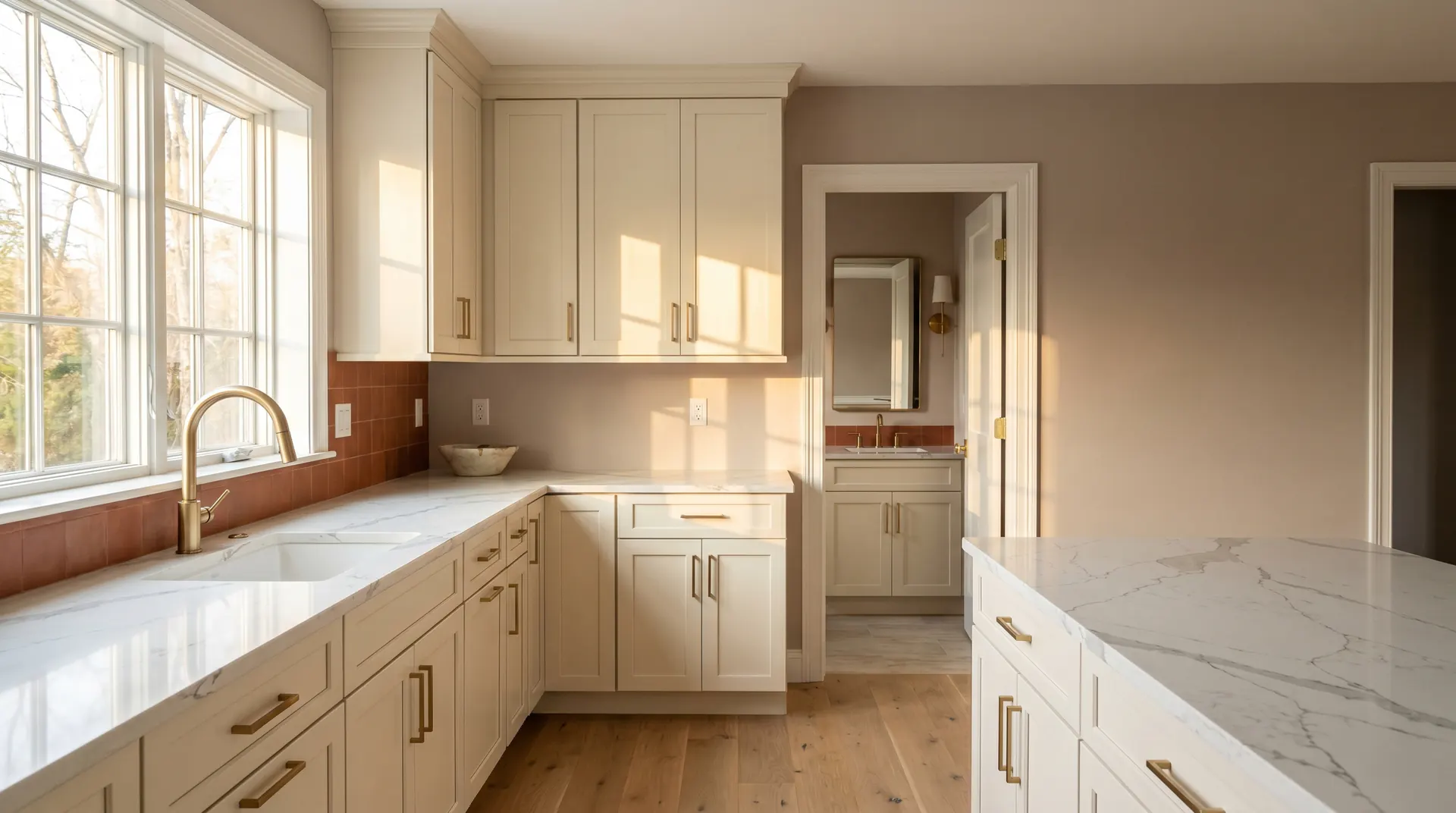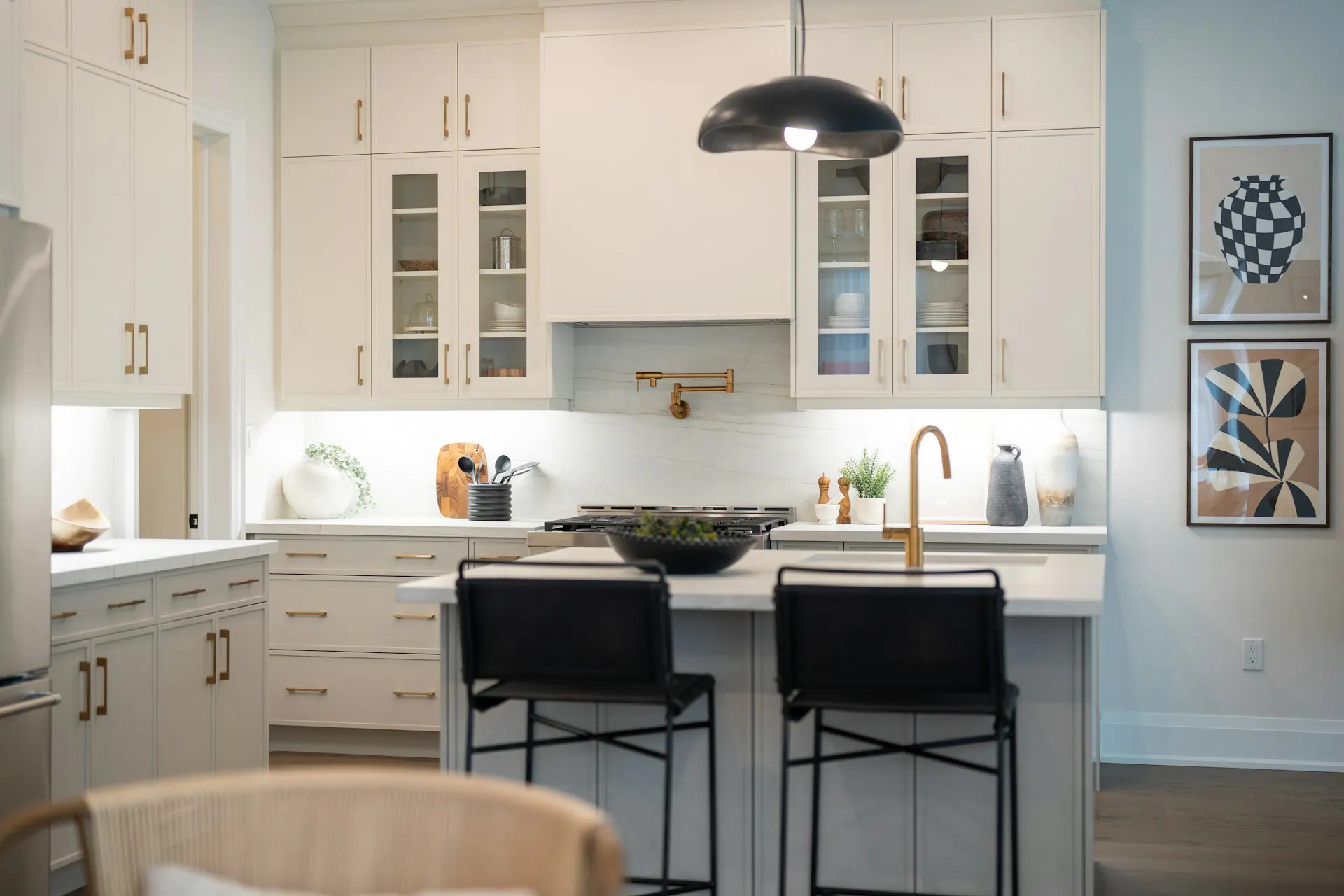
Kitchen renovation cost in Bergen County, NJ is one of the first questions homeowners ask and one of the last ones they get a real answer to. The reason is structural, not evasive — until the scope is defined, the cabinet line is selected, the layout decisions are made, and a contractor has walked the actual kitchen, the number does not exist as a single figure. It exists as a range. This guide explains the bands kitchen renovations typically fall into in Paramus and Bergen County, what drives a project up the band, what drives it down, and how to translate a planning-stage band into a real quote.
Why kitchen cost is hard to pin down up front
Two homeowners with kitchens of identical square footage in the same Paramus neighborhood can spend very different amounts on a renovation. The reasons compound: scope (refresh vs full program), cabinet tier (stock vs semi-custom vs custom), counter material (entry-level quartz vs natural stone), layout changes (moving plumbing and gas), appliance tier (mid-market vs professional), and the surprises that demolition uncovers in older Bergen County homes.
Recent regional remodeling cost data places Bergen County kitchen costs consistently 15 to 25 percent above national medians. Sweeten’s New Jersey kitchen remodeling cost guide reports budget-tier full renovations starting around 28,000 dollars, mid-tier programs starting around 81,000 dollars, and high-end programs starting around 170,000 dollars before any custom or structural scope. The 2025 U.S. Houzz Kitchen Trends Study places the national kitchen-remodel median at roughly 60,000 dollars, with the 90th percentile of major high-end remodels at 180,000 dollars or more. A national “kitchen renovation cost” range read from the first search result almost always understates what a Bergen County project actually runs.
The honest answer to “how much will my kitchen cost” is a band that the rest of the planning process narrows. The bands below are framed by scope, not by exact dollar figures, because the band is what stays useful through planning; the exact figure is what a showroom selection plus a contractor scope eventually delivers.
Cost ranges by project tier
Refresh-scope projects
A refresh keeps the existing kitchen layout. Cabinets are refaced or fronts are replaced, the counter is replaced, the backsplash is updated, lighting and hardware refresh, and plumbing stays in place. Demolition is light. Permits are usually not required when no electrical or structural work happens.
In Bergen County, refresh-scope projects sit at the lower end of regional remodeling data — the band national sources call “minor kitchen remodel.” For Paramus, Fair Lawn, and Hackensack homes with intact existing layouts, refresh-scope is the most cost-effective way to upgrade the kitchen visually and gain meaningful resale lift. The trade-off: storage and workflow problems baked into the existing layout do not get solved.
Mid-program renovations
A mid-program renovation replaces cabinets entirely with semi-custom lines, replaces counters with quartz or mid-tier natural stone, refreshes appliances, redoes flooring within the kitchen footprint, and may relocate one or two electrical or plumbing fixtures. Layout stays mostly intact; permits are usually required.
This is the most common scope across Bergen County kitchens. Recent regional cost data places mid-program renovations meaningfully above refresh-scope — typically two to three multiples — with the spread driven mostly by cabinet line tier and counter material choice. Tenafly, Englewood, Ridgewood, and Glen Rock kitchens in this scope often add a custom storage program and premium hardware that lift the upper end further.
Full-program renovations
A full-program renovation redraws the layout, replaces all cabinets with semi-custom or custom lines, replaces counters with quartz or premium natural stone, replaces all appliances, may move walls or knock through to a dining area, moves plumbing and gas, and frequently upgrades electrical service to support induction and double-oven loads.
Full-program scope sits at the top of regional kitchen cost data — typically several multiples above refresh-scope. Tenafly and Englewood center-hall colonials with full-program renovations including custom cabinetry, integrated paneled appliances, and stone slab counters routinely run at the high end of the published Bergen County range. The honest band is wide because the variables stack: cabinet tier, counter slab tier, appliance tier, and structural change all multiply.
What drives kitchen cost up
The line items that move the budget the most, ranked roughly by impact:
- Cabinet line tier. Stock cabinets, semi-custom cabinets, and full-custom cabinetry differ by a multiple for the same footprint. Cabinets are usually the largest single line in a kitchen budget.
- Layout changes. Moving the sink wall, relocating the range, or knocking out a wall to open the kitchen to a dining room each carry their own subcontractor coordination, framing, electrical, and plumbing cost.
- Counter material. Entry-level quartz, mid-tier quartz, mid-tier natural stone, and premium book-matched stone slabs sit on a steep curve. Edge profile compounds it.
- Appliance tier. Mid-market, premium, and professional appliance packages can vary substantially. Built-in refrigeration, dual-fuel ranges, and integrated paneling lift the band.
- Plumbing and gas relocation. Even short-distance moves require permits and licensed trade work. The cost is not the move itself; it is the cascade of inspection and finish work that follows.
- Hidden conditions. Older Hackensack pre-war homes, Paramus singles built before 1970, and Fair Lawn split-levels routinely uncover undersized framing, retired chimneys inside walls, deteriorated wiring, or compromised subfloor — only visible after demolition.
What drives kitchen cost down
The decisions that hold the budget without giving up project quality:
- Stay refresh-scope when the layout works. If the existing kitchen has intact workflow and adequate storage, a refresh delivers most of the visual lift at a fraction of the full-program cost.
- Keep plumbing and gas in place. Reusing the existing wet-wall and range location removes the most expensive cascade in the project.
- Refacing instead of replacing cabinets when the cabinet boxes are still solid. Refacing replaces doors and fronts but keeps the existing carcasses; structurally sound boxes in good condition can support new fronts cleanly.
- Choose a cabinet line that fits the home, not one tier above it. Custom cabinetry earns its cost in unusual room geometries and historic homes; in standard Paramus and Fair Lawn footprints, semi-custom lines deliver equivalent visible quality at meaningfully lower spend.
- Decide finishes once. Re-selection during construction adds cost in change orders and lost time. The 10 to 15 percent contingency is for hidden conditions, not for finish revisions.
Bergen County housing context and the cost band
The cost band a kitchen falls into is shaped meaningfully by the home it sits in.
Compact pre-war kitchens in Hackensack, Teaneck, and older Paramus singles tend to run efficient on cabinet quantity but expensive on hidden conditions. Smaller cabinet runs cost less; demolition surprises cost more. Refresh-scope and mid-program projects often deliver strong value here. Full-program renovations get expensive quickly when wall framing, retired chimneys, or undersized electrical panels show up during demolition.
Mid-century split-levels in Fair Lawn and parts of Paramus typically have galley or compact L-shape kitchens. Layout-respect renovations — keeping the existing geometry and upgrading cabinets, counter, and surfaces — run more cost-effective than reconfiguration. Knocking through walls in split-levels is often more expensive than the same move in a colonial because the structural framing tends to be more involved.
Transitional renovated colonials in Tenafly, Englewood, Ridgewood, and Glen Rock support more ambitious mid-program and full-program scopes. Larger kitchens take more cabinet linear footage, more counter square footage, and more lighting circuits — every line item scales up. Full-program renovations in these homes routinely sit at the higher end of the published Bergen County range.
The path from a band to a real number
A planning-stage band becomes a real number through three steps:
- Showroom selection. Walking through cabinet lines, counter slabs, tile, and fixtures with a specialist turns “semi-custom cabinets” into a specific line, finish, and price. The same exercise pins down counter material, tile selection, and hardware. This is the step that converts the cabinet line tier — the single biggest cost driver — from a category into a number.
- Contractor walkthrough. A contractor walking the actual kitchen identifies layout constraints, plumbing and electrical conditions, and any structural questions that affect scope. The contractor’s bid is the labor side of the number.
- Final spec. Cabinet selection plus contractor scope plus a contingency line gives a budget the project can hold. The contingency exists for surprises uncovered during demolition; it is not a buffer for selection changes.
Skipping any of these steps produces a guess, not a number. The guess is fine for early planning; it is not a basis for committing.
When the cabinet direction is clear and the layout has been thought through, the next step is product selection in person. Continue with Anve Kitchen and Bath in Paramus to compare cabinet lines, counter slabs, and tile from the lines covered across this site — and to start translating a planning band into a real quote.
For broader project planning, see the kitchen remodeling guide. For cabinet selection mechanics, see how to choose kitchen cabinets. To prepare for a productive product conversation, the kitchen showroom visit checklist covers what to bring and what to ask.