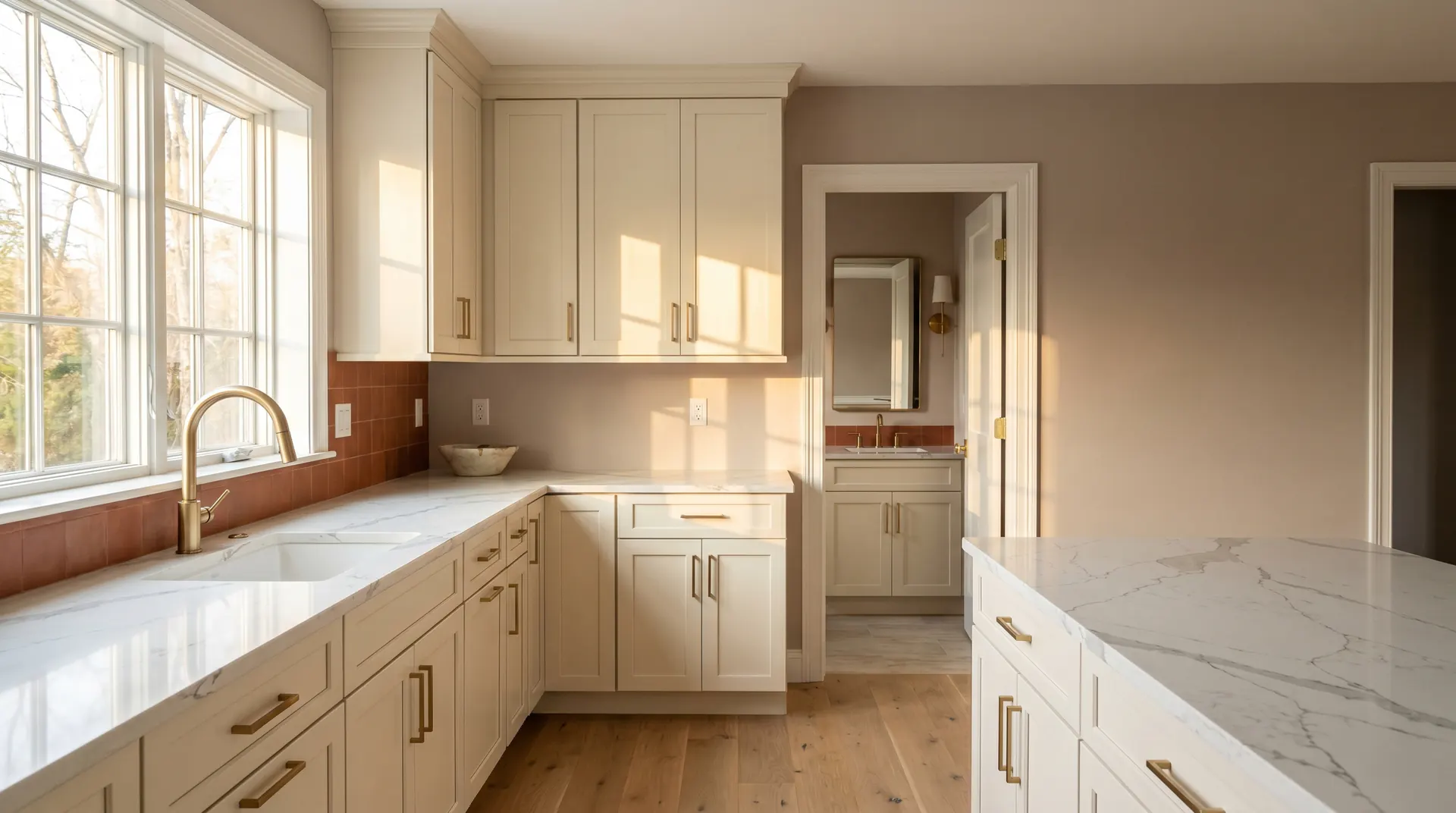
The most common kitchen renovation regrets in Bergen County are predictable. After enough planning conversations across Paramus, Hackensack, Fair Lawn, Tenafly, Englewood, Ridgewood, and Glen Rock, the same five mistakes show up again and again — different homeowners, different budgets, different home eras, but the same five patterns. This guide covers the five that come up most often, what they look like in practice, and how to avoid each one before it costs anything.
1. Choosing the cabinet line one tier above what the home actually needs
The first mistake is selecting a cabinet line that exceeds what the home and the market actually call for. Custom cabinetry in a standard Paramus single is overkill; semi-custom usually delivers equivalent visible quality at meaningfully lower spend, and the difference rarely shows up in daily use or resale.
The mistake looks like a homeowner walking into a showroom, looking at the most expensive cabinet program available, and treating that program as the standard from which everything else is a compromise. The line tier becomes a status decision instead of a fit decision. Custom cabinetry earns its premium when room geometry is unusual, when a historic home demands trim integration the catalog cannot match, or when the household’s intended length of stay justifies a long-horizon investment. In a typical Bergen County footprint, those conditions rarely apply.
A common pattern: a Fair Lawn split-level with a galley kitchen and standard ceiling heights gets specified with full custom cabinetry at a meaningful premium over a comparable semi-custom program. Once installed, the visible difference is small — the same Shaker door, the same painted finish, the same hardware. The premium does not earn itself back in resale, and the household does not notice it during cooking.
Avoiding the mistake is straightforward: read the home era and the home market honestly, then pick the tier that matches. The kitchen renovation cost guide covers cabinet tier as the largest single budget driver. The cabinet buying guide covers how to narrow line tier against home era and length-of-stay intent. Choosing semi-custom for a home that does not require custom is not a downgrade; it is a fit.
2. Moving plumbing or gas without budgeting the cascade cost
The second mistake is relocating plumbing or gas lines without budgeting the cascade of work that follows the move. The cost is rarely the move itself; it is the framing, electrical, finish, and inspection cascade that follows. Bergen County kitchens with relocated sink walls routinely run 20 percent higher than otherwise-identical scopes.
The mistake looks like a homeowner deciding mid-planning to shift the sink to the window wall or move the range from one side of the kitchen to the other, with the relocation priced as a single trade line. The plumber’s bid for the move itself is usually modest. The cascade is not. Moving the sink wall opens framing, requires new electrical for a relocated dishwasher and disposal, drives new venting, demands subfloor patching, and adds inspection steps that other scopes skip. The same is true for gas line relocation behind a moved range — new copper or black iron run, new shutoff, recertified appliance hookup, and an inspection that has to pass before drywall can close.
A representative pattern: a Tenafly colonial renovation calls for moving the sink from a peninsula to a window wall to gain a view. The plumbing line move is a few thousand dollars on paper. The actual cost — framing rework, redirected electrical, refinished hardwood across the old sink footprint, and a longer inspection sequence — adds 15 to 20 percent to the project total. The homeowner often discovers this only when the change order arrives.
Avoiding the mistake means asking the contractor to price the cascade, not the move. If the existing layout works, leave the wet-wall and gas line in place. If the layout genuinely fails — the sink blocks traffic, the range has no landing space — the relocation may pay for itself in long-term daily use. The decision is workflow against budget, not aesthetics against budget. The kitchen remodeling guide covers when to move plumbing and when to leave it.
3. Selecting counter, backsplash, and cabinets in the wrong order
The third mistake is reversing the surface decision sequence. Cabinets first, then counter, then backsplash. Choosing a counter first locks the room into a palette before the dominant surface is decided.
The mistake looks like a homeowner falling for a particular stone slab early — a striking quartzite, a bookmatched marble, a heavily veined quartz — and then trying to find a cabinet color that works against it. The cabinet finish carries far more visual weight in a kitchen than the counter; it is the dominant surface by area, by sightline, and by light reflection. Choosing the counter first inverts the hierarchy. The cabinet selection that follows is constrained, the backsplash gets squeezed between two already-fixed surfaces, and the room ends up reading as a series of surfaces fighting each other rather than a coordinated palette.
A common pattern: a Ridgewood kitchen renovation starts with a slab the homeowner saw at a stone yard, gets specified with a cabinet finish chosen from limited options that did not clash with it, and arrives at a backsplash decision where every tile family looks wrong. The reselection that follows usually means a delay of two to four weeks and a backsplash that compromises rather than resolves the palette.
Avoiding the mistake costs nothing. Sequence the surfaces in the right order: home context first, cabinet style and finish second, counter material and color family third, backsplash fourth. The cabinet decision narrows the counter palette; the counter decision narrows the backsplash. Each later decision is constrained by the earlier ones, which is the point — constrained decisions are easier to make, not harder.
4. Loading every cabinet with accessories instead of solving real problems
The fourth mistake is specifying storage accessories cabinet-by-cabinet instead of problem-by-problem. Targeted accessories return value; loading every cabinet adds cost without help.
The mistake looks like a showroom conversation that walks through the cabinet run and adds an organizer, pull-out, divider, or insert to nearly every box. The line items add up — the per-cabinet accessory cost is modest, but multiplied across twenty cabinets, the total becomes meaningful. More importantly, the accessories rarely match real friction. A pull-out trash cabinet is high-value when the existing kitchen has no dedicated waste cabinet; specifying one in a kitchen that already handles waste cleanly returns nothing. A vertical tray divider is high-value when the household has trays that currently live in awkward stacks; specifying one in a household that does not own trays is dead weight in the budget.
A representative pattern: a Glen Rock kitchen gets specified with full accessory loadout — pull-out waste, pantry pull-outs, deep drawers, tray dividers, drawer inserts in every drawer, charging stations, spice pull-outs — without an inventory of which problems any of those features solve. Six months after install, the household uses three of the eight accessory categories. The other five sit empty or serve as low-utility storage. The premium paid for them is sunk.
Avoiding the mistake takes one exercise: walk the existing kitchen with a notepad, list the storage problems, then accessorize against the list. The cabinet buying guide covers the storage program in more detail. Common high-value additions — pull-out waste, deep drawers under cooktops, vertical tray dividers, pantry pull-outs — earn their cost when a real problem exists for them to solve. Without that problem, they are line items, not features.
5. Skipping the contingency line on pre-1970 housing stock
The fifth mistake is treating the contingency line as optional in older Bergen County homes. Hackensack pre-war singles, Paramus singles built before 1970, and Fair Lawn split-levels routinely uncover hidden conditions during demolition. A 10 to 15 percent contingency is non-negotiable.
The mistake looks like a homeowner pricing the project to the base budget and treating the contingency as a buffer that might not be needed. Once demolition opens walls, the buffer is needed nearly every time. Pre-war Hackensack homes routinely reveal retired chimneys inside walls, undersized joists, deteriorated subfloor under the original linoleum, and wiring that fails to current code. Paramus singles built before 1970 frequently have framing rebuilt without permits during prior owners’ tenures, panels too small for induction or double-oven loads, and gas lines that need recertification. Fair Lawn split-levels often hide compromised structural elements between floor levels that only become visible when cabinets and drywall come out.
A typical pattern: a Hackensack pre-war kitchen gets quoted at a tight base number and demolition reveals a retired brick chimney inside a wall the new layout assumed was framed conventionally. The chimney removal, structural patch, and electrical rerouting around it costs 8 to 12 percent of the base budget. Without a contingency line, this becomes a change order conversation under pressure; with a contingency line, it is the work the contingency exists for.
Avoiding the mistake is a budgeting discipline, not a planning one. Hold 10 to 15 percent on top of the base, label it explicitly as contingency for hidden conditions, and treat it as separate from the spending budget. The contingency is for discoveries during demolition, not for shopping changes during construction. The cost guide covers Bergen County housing stock context in detail. In pre-1970 housing, the contingency line is the difference between a project that finishes on budget and one that finishes with a regret.
What these five mistakes have in common
The pattern across all five regrets is the same: each one comes from a decision made before the planning work that should precede it is finished. Cabinet tier gets locked before the home and market context is read honestly. Plumbing relocation gets approved before the cascade is priced. Surface selections get made out of sequence. Accessories get specified before the storage problems are inventoried. Contingency gets cut before hidden conditions are accounted for. The mistake is not in the decision itself; it is in the timing — committing to a line item before the analysis that decision depends on has been done. The homeowners who avoid these mistakes are the ones who treat planning as the work, and product selection as the result of the work.
When you are ready
When the plan is in shape — cabinet tier matched to home, layout decisions made with cascade cost in mind, surface sequence settled, storage program built around real problems, contingency held for the discoveries demolition will surface — the next step is product selection in person. Continue with Anve Kitchen and Bath in Paramus to compare cabinet samples, counter slabs, tile, and fixtures from the lines covered across this site. For the broader cost picture, see the kitchen renovation cost guide. For the full project sequence, see the kitchen remodeling planning guide. For cabinet selection mechanics, see how to choose kitchen cabinets.