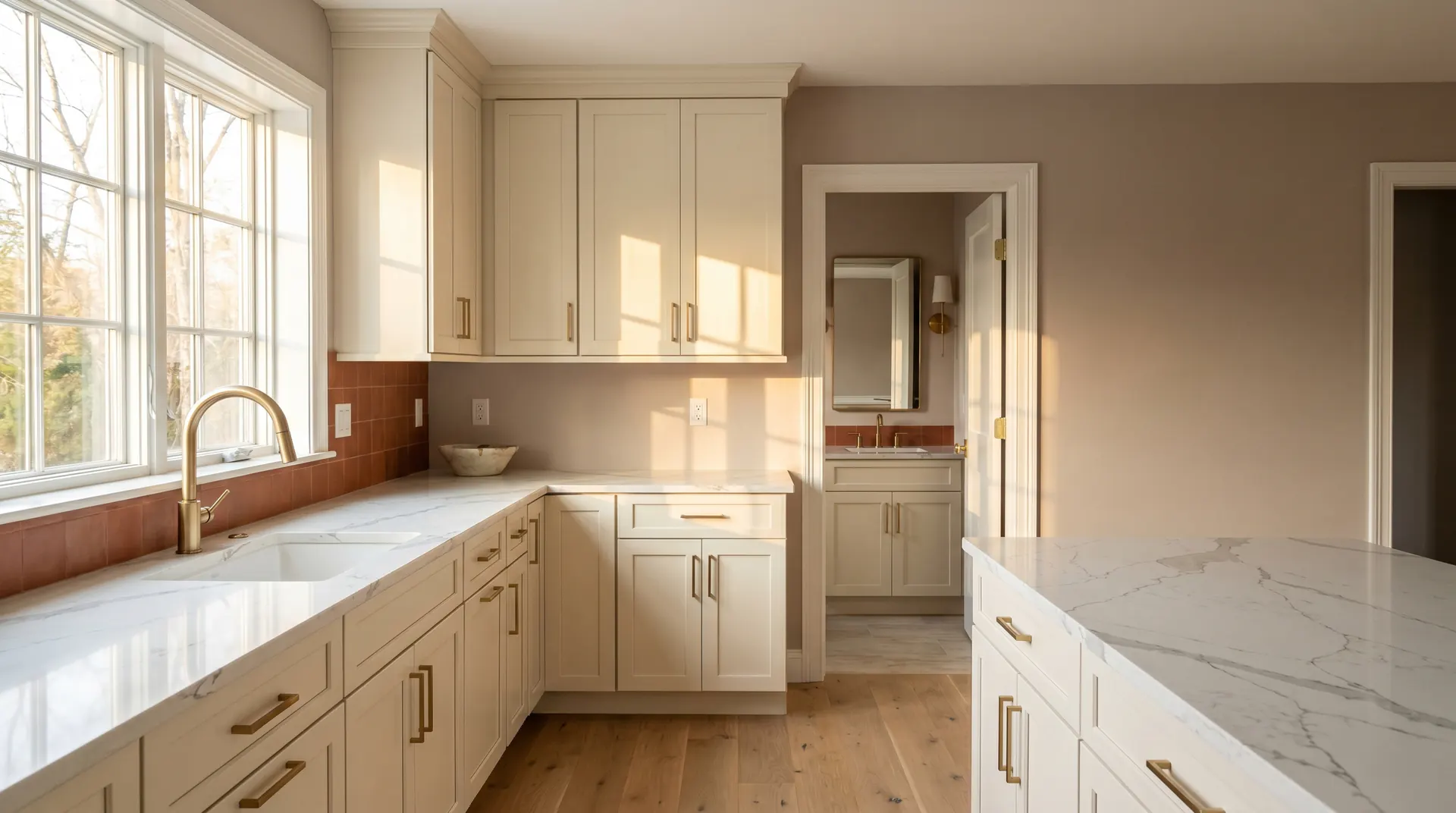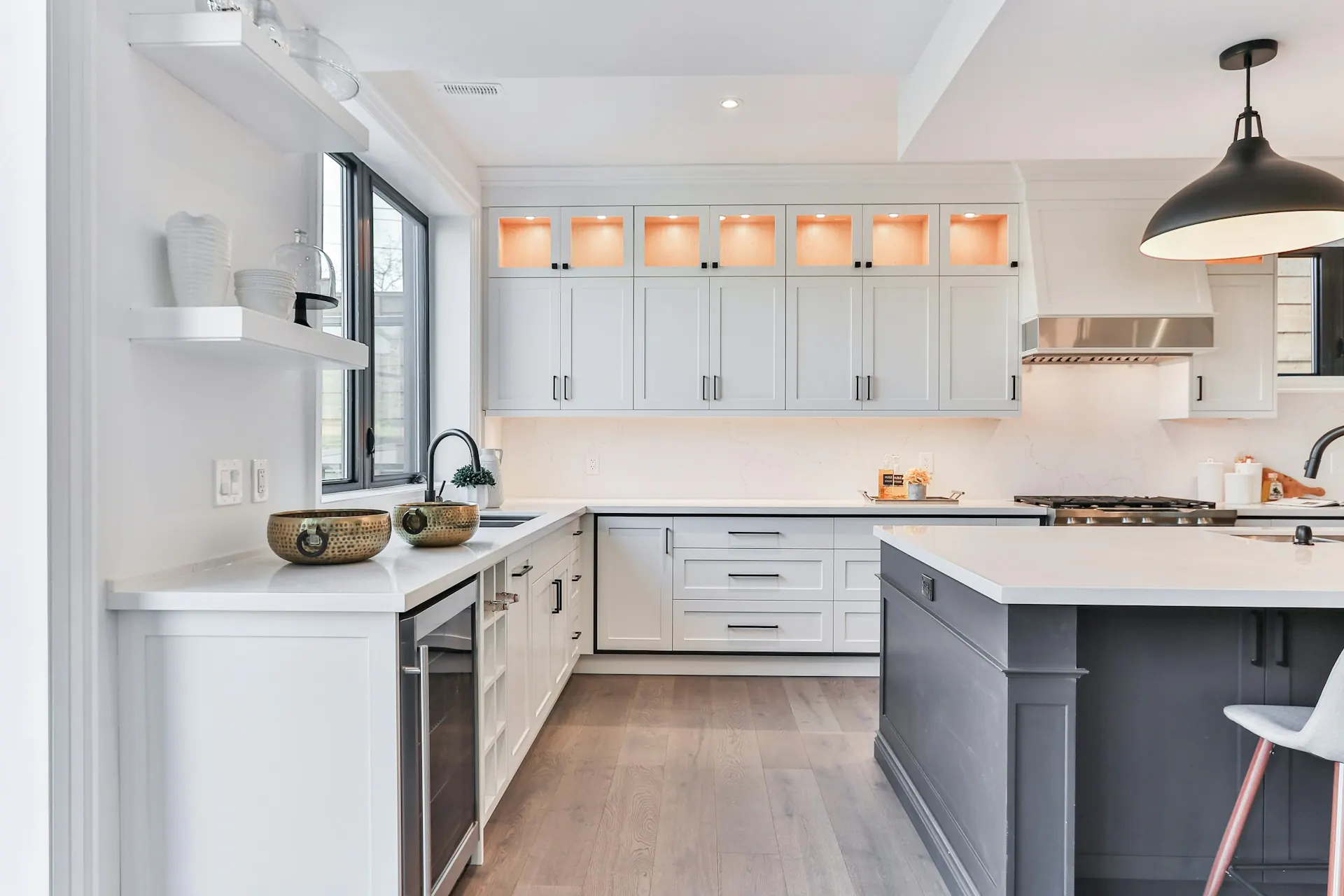
Kitchen cabinets are the single largest visual surface in the room and one of the larger budget lines in a remodel. Choosing them well is less about picking a favorite door style and more about working through a sequence of decisions in the right order. This guide walks through that sequence — room context, style, construction, finish, storage, budget — so the cabinets that arrive on the truck are the ones that actually fit the home.
What this guide covers
A practical algorithm for cabinet selection in Paramus and Bergen County homes: how to read the home era, how to narrow style direction, how to compare framed and frameless construction, how to pick a finish that ages well, how to think about storage accessories, and how to set a budget that holds.
Step 1 — Room context first
Before considering door styles, look at the room. Cabinet decisions follow from architecture, not the other way around. A 1960s Paramus single, a 1920s Hackensack pre-war, a 1980s Fair Lawn split-level, and a renovated Tenafly colonial each carry different proportions, ceiling heights, and architectural detail. The cabinet style that reads beautifully in one of those will read off in another.
Ask: what is the home era? What is the architectural language of the rest of the first floor? Does the kitchen open to a formal dining room or to an informal family space? The right answers narrow the cabinet direction long before a door sample lands on the counter.
Step 2 — Door style direction
Once the home context is clear, narrow door style. The most common directions in Bergen County kitchens:
| Door style | Best fit by home era | Maintenance footprint |
|---|---|---|
| Shaker | All eras — colonial, ranch, transitional, renovated singles | Low. Refinishable. Painted shows chipping at corners over time. |
| Slab / flat-panel | Modern and contemporary renovations | Low cleaning. Dust and fingerprints visible on matte and dark finishes. |
| Inset | Historic and high-end traditional homes | Higher. Demands precise installation; seasonal wood movement may need adjustment. |
| Raised panel | Traditional and classical homes | Higher. Detail traps dust and grease. |
| Beaded inset | Transitional homes wanting historic detail | Mid. More cleaning than Shaker. |
| Rift-cut white oak slab | Transitional and modern Bergen County renovations | Mid. Sealed periodically. |
| Two-tone (island accent) | Any era — used as accent only | Color contrast can date faster than the door style. |
Shaker is the default for a reason — it works in nearly every era, tolerates both painted and stained finishes, and ages well. Slab is the right choice when the home is genuinely contemporary, not when the homeowner just wants a contemporary kitchen in a traditional home.
Step 3 — Construction: framed or frameless
Framed cabinets carry a face frame on the front of the box. The frame slightly reduces the door opening, gives a more traditional read, and tolerates out-of-square walls — which matters in pre-war Hackensack and older Paramus homes where wall conditions are imperfect.
Frameless cabinets skip the frame, attach hinges directly to the box, and present a cleaner front. Interior storage volume is marginally larger, and the look reads more contemporary. Frameless installations are less forgiving of rough wall conditions, so the contractor needs to true the run carefully.
Neither construction is universally better. Match construction to home era and to the level of finish detail elsewhere in the kitchen.
Step 4 — Finish direction
Cabinet finishes break into three families:
Painted finishes give consistent color and a clean look. Quality programs hold up well in family kitchens but show chipping at heavily used corners over time. Touch-up is straightforward when the finish is documented at install.
Stained natural wood finishes read warmer, hide minor wear better, and refresh well. Walnut, white oak, and rift-cut oak are the most common contemporary directions; cherry and maple are common in traditional kitchens.
Sealed natural wood finishes sit between painted and stained. The grain shows through, the finish protects, and small wear blends in.
The finish decision should consider how the household uses the kitchen, how the cabinet color relates to the counter and backsplash that will sit against it, and how the kitchen reads in the home’s overall palette.
Step 5 — Storage that solves real problems
The storage accessories worth paying for are the ones that solve a problem the current kitchen actually has. The exercise:
- Walk the existing kitchen with a notepad
- Write down the storage problems — cluttered drawers, awkward corner cabinets, pantry overflow, no landing space, hard-to-reach upper cabinets
- For each problem, identify the cabinet accessory that would fix it
Common high-value additions include deep drawers under cooktops for pots, vertical dividers for trays and cutting boards, pull-out waste cabinets, pantry pull-outs, drawer organizers for cutlery and utensils, and a charging drawer near the prep zone. Loading every cabinet with accessories adds cost without help; targeted accessories return real daily value.
Step 6 — Budget and lead time
Cabinet pricing is driven by line tier (stock, semi-custom, custom), construction (framed or frameless), door style, finish complexity, and accessory load. The same kitchen footprint can vary by a multiple across these tiers. The honest budgeting question is not “what is the cheapest line that looks good,” but “what tier matches the home’s market and the household’s intended length of stay.”
Lead times shift seasonally. Stock lines arrive fastest; semi-custom typically runs six to ten weeks; full custom runs twelve weeks or more. Order before demolition starts, not after.
Anti-patterns to avoid
A few cabinet decisions that consistently produce regret in Bergen County kitchens:
- Choosing a peak-trend cabinet color (high-saturation greens, blues, or warm browns) for the entire kitchen rather than as an island accent
- Specifying inset construction without budgeting for the higher install cost and ongoing seasonal adjustment
- Loading every cabinet with accessories rather than targeting the ones that solve real problems
- Picking the door style and finish before walking the home’s first floor with a designer
For style by home era, see Bergen County cabinet styles. For the broader project context, see kitchen remodeling planning. To prepare for the showroom step, use the kitchen showroom visit checklist.
When you are ready
When the cabinet direction is clear — home era understood, door style narrowed, construction chosen, finish family settled, storage program drafted — the next step is comparing actual cabinet samples in person. Continue with Anve Kitchen and Bath in Paramus to see the lines covered across this site, in finish and at full size.