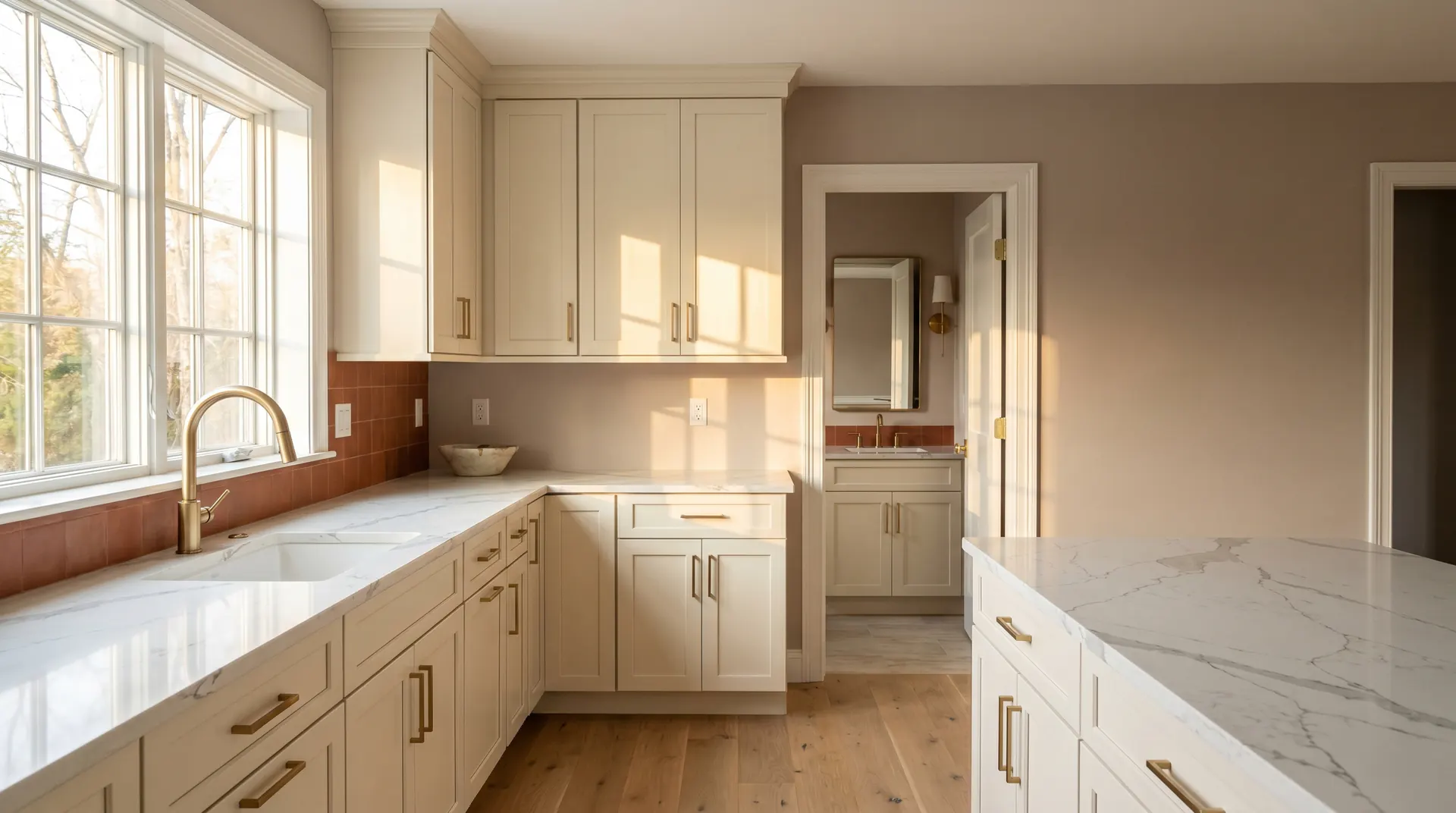
Framed cabinets carry a face frame on the front of the box; frameless cabinets skip it. The choice tracks home era, wall condition, and how clean a front the kitchen wants to read. In Bergen County, pre-war Hackensack and Paramus pre-1970 housing favors framed construction because the frame absorbs out-of-plumb walls and uneven floors without revealing them. Renovated colonials and contemporary kitchens accept either; the decision shifts to finish detail and storage preference.
This is a comparison guide focused on construction, not door style. If you want the full cabinet buying sequence, how to choose kitchen cabinets walks the order of operations. If you are weighing door silhouettes, Shaker vs slab kitchen cabinets in Bergen County covers that question separately. Construction and door style are independent decisions — Shaker comes in framed and frameless, slab comes in framed and frameless — and most homeowners benefit from settling them one at a time.
The 30-second answer
For most older Bergen County homes, framed is the safer construction and frameless is the higher-conviction one. Framed tolerates imperfect walls, accepts partial-overlay or full-overlay door treatments, and reads comfortably in nearly every era of housing stock. Frameless demands trued wall conditions, reads cleanest with full-overlay doors, and rewards genuinely contemporary or aggressively renovated kitchens with a flatter, less interrupted front. The verdict map below is the short version of the rest of this guide.
| Bergen County context | Default verdict |
|---|---|
| Hackensack pre-war and pre-1940 stock | Framed |
| Paramus pre-1970 single or ranch | Framed |
| Fair Lawn split-level | Framed (frameless when walls have been trued) |
| Tenafly center-hall colonial | Framed (frameless on aggressive renovations) |
| Ridgewood Victorian | Framed |
| Renovated transitional, walls trued | Either, follow finish detail |
| Contemporary new build or full gut | Frameless |
The construction question is more about wall condition and install discipline than about taste. Framed cabinets forgive; frameless cabinets reveal. Most older Bergen County kitchens are honest about that fact within five minutes of a measure visit.
Framed cabinets — how they are built and where they work
A framed cabinet has a face frame attached to the front edge of the cabinet box — a flat ladder of solid wood, typically one and a half inches wide on the stiles and rails, that wraps the front opening. Hinges mount into the face frame rather than into the side panel of the box. Doors can sit inset (flush with the frame), partial-overlay (covering most of the frame with a quarter inch reveal), or full-overlay (covering nearly all of the frame). The face frame is the structural and visual anchor of the cabinet front.
In Bergen County, framed construction fits the housing stock with practical reliability. A 1925 Hackensack pre-war kitchen with walls that have shifted a quarter inch over a century takes framed cabinets without a fight; the face frame gives the installer scribe room to absorb the misalignment. A 1958 Paramus single with a floor that slopes a sixteenth of an inch toward the back wall does the same. A Fair Lawn split-level kitchen where the soffit was added at some unknown decade and runs slightly off-line accepts framed cabinets cleanly because the frame, not the box, defines the visual front of the run.
The maintenance footprint and finish behavior are equivalent to frameless — there is no inherent durability difference between the two constructions in the same line tier. What differs is the door treatment range. Framed cabinets accept inset doors, which sit flush with the face frame and produce a high-end traditional read; frameless cabinets do not support true inset because there is no frame for the door to sit inside. Framed cabinets also accept partial-overlay treatments that read more period-correct in older homes.
Where framed construction falls short is in genuinely contemporary kitchens. The face frame interrupts the front plane and reads as an extra horizontal and vertical line at every cabinet division. In a kitchen designed to read as a continuous quiet front — slab doors, integrated panels, minimal hardware — framed construction fights the intent. Frameless is the right answer for that brief.
Frameless cabinets — how they are built and where they work
A frameless cabinet has no face frame. The door mounts directly to the side panel of the cabinet box using cup-style hinges, and the door overlays the box almost edge-to-edge with only a small reveal between adjacent doors. The cabinet front reads as a quiet field of door faces with thin lines between them — no frame, no rails, no stiles, just the doors. Interior storage volume is marginally larger because there is no frame narrowing the opening, and drawer boxes can run wider for the same external cabinet width.
Frameless construction fits genuinely contemporary kitchens and aggressively renovated transitional homes. A Paramus single that has been gutted, opened to the dining and living rooms, and finished with flat-stock baseboards and minimal trim takes frameless cabinets cleanly. A Westwood transitional renovation where the kitchen was extended into the original mud room and the entire run was framed out new accepts frameless without a fight because the walls were built for the cabinets, not the other way around. A new build or a down-to-the-studs renovation in any town gives frameless its best conditions.
The install discipline is higher. Frameless cabinets reveal wall conditions immediately because the door faces sit forward of the box and any misalignment shows as an inconsistent reveal between adjacent doors. The contractor needs to confirm wall plumb, floor level, and ceiling line before the boxes go up; in older homes that often means shimming the boxes carefully or correcting the wall condition with drywall and shimming work. The labor cost difference at install is real and shows up on careful contractor estimates.
The finish detail benefit is real. A long uninterrupted frameless run with full-overlay slab or Shaker doors reads as a calm continuous field that framed construction cannot quite match. For homeowners who want a contemporary kitchen and have walls that can support the discipline, frameless delivers a result framed cannot replicate. The trade is that the conditions have to be there.
Where frameless construction falls short is in older homes with imperfect walls and in kitchens that genuinely want a traditional read. Inset is unavailable, partial-overlay is unavailable, and the look is fundamentally contemporary even when the door style is Shaker. A frameless kitchen in a fully period Ridgewood Victorian or a heavily detailed Tenafly center-hall reads as an oversight against the rest of the first floor. Framed construction, with inset or partial-overlay Shaker, is the correct answer for those homes.
Side-by-side comparison
| Dimension | Framed | Frameless |
|---|---|---|
| Face frame | Solid wood face frame, ~1.5” wide stiles and rails | None; door mounts directly to box side panel |
| Door overlay options | Inset, partial-overlay, full-overlay | Full-overlay only |
| Hinge mounting | Into the face frame | Cup hinges into the box side panel |
| Interior storage volume | Slightly less; frame narrows opening | ~10–15% more per cabinet of same external size |
| Wall-condition tolerance | High; frame gives scribe room for older walls | Lower; demands plumb walls and level floors |
| Install demands | Forgiving; standard install discipline | Higher; walls trued before boxes go up |
| Country-of-origin pattern | Historically American; now made globally | Originated in postwar Europe; now made globally |
| Price tier | Available across stock, semi-custom, custom | Same range; install labor sometimes higher |
| Retrofit difficulty | Easier; tolerates existing wall conditions | Harder; existing wall corrections often needed |
The table is silhouette-neutral. A Shaker door comes in framed and frameless; a slab door comes in framed and frameless. Construction is independent of door style and should be decided independently.
Which construction fits which Bergen County home
The construction decision starts with the home and the walls. The summary below maps the two constructions against the most common Bergen County housing contexts.
Hackensack pre-war and pre-1940 stock. Framed. Walls in pre-war Hackensack housing have shifted over a century — out of plumb by an eighth to a quarter inch is normal, more in some homes — and the face frame absorbs that condition without revealing it. Inset and partial-overlay door treatments work in framed and read as period-correct. Frameless can be installed in pre-war homes but only after the walls are corrected, which adds drywall and framing labor to the project. Most pre-war kitchens land on framed for honest reasons.
Paramus and Fair Lawn pre-1970 stock. Framed. The 1950s and 1960s singles and ranches that make up much of Paramus and parts of Fair Lawn carry walls that are usually plumb but rarely perfect, floors that have settled slightly, and original framing dimensions that do not always match modern cabinet boxes. Framed construction tolerates all three conditions. Frameless works when the renovation is aggressive enough to true the walls and re-frame the soffit, but in modest updates where the existing walls and floors stay, framed is the practical answer.
Fair Lawn split-level kitchens. Framed by default; frameless when the renovation is end-to-end. Split-level kitchens are tighter and lower-ceilinged, which makes frameless cabinets attractive for the storage volume gain — every inch of interior counts at that scale. The catch is the wall condition: split-level kitchens often carry an added soffit, an added bulkhead, or a non-original wall section that runs slightly off-line. Framed accepts those conditions; frameless reveals them. If the renovation is taking walls to studs and re-framing the soffit, frameless is open. If not, framed is the safer choice.
Tenafly and Englewood center-hall colonials. Framed is the default. The formal first-floor architecture supports the rail-and-stile reading of framed cabinets, and inset construction (only available framed) is a common direction in higher-end Tenafly programs. Frameless works in renovations where the kitchen has been pulled contemporary and the rest of the first floor has been pulled with it; in renovations that maintain the colonial language, framed is the correct answer.
Ridgewood Victorians and period traditionals. Framed. The construction supports inset doors, which read most period-correct, and tolerates the wall conditions of older homes. Frameless reads as a disconnect against the period detail of the rest of the first floor in nearly every case.
Renovated transitional, walls trued. Either construction works. The decision shifts to finish detail — does the kitchen want a small reveal at every cabinet division (framed, partial-overlay) or a continuous front (frameless, full-overlay)? Walk a designer through the rest of the first floor and let the answer fall out.
For deeper coverage of these era-by-town pairings, see kitchen cabinet styles for Bergen County homes.
Price and lead-time differences
Within the same cabinet line, framed and frameless price within a few percent of each other on the cabinet itself. Construction is not the dominant cost driver — line tier (stock, semi-custom, custom), door style, finish complexity, and accessory load carry more of the budget. A semi-custom framed kitchen and a semi-custom frameless kitchen at the same line, same finish, and same accessory load will land in the same ballpark on the cabinet invoice.
Where price separates is at install. Frameless cabinets in older Bergen County homes often require additional labor and sometimes drywall work to true the wall run before the boxes go up. A pre-war Hackensack kitchen specified frameless can carry a meaningfully higher install line than the same kitchen specified framed because the wall preparation is more involved. Modern renovations where the walls are already trued or freshly framed do not see this delta.
Inset construction — which is only available framed — sits at a higher tier than partial-overlay or full-overlay framed cabinets because the install tolerance is tighter and seasonal wood movement may need adjustment over the first year. Inset is a finish-detail decision, not strictly a construction decision, but it is worth flagging here because it is only an option on framed cabinets.
Lead times are construction-neutral but line-tier sensitive. Stock cabinet lines arrive in two to four weeks regardless of construction. Semi-custom typically runs six to ten weeks. Full custom runs twelve weeks or more. Order before demolition starts. Lead times shift seasonally — confirm the current estimate at the showroom step.
Anti-patterns to avoid
A few cabinet construction decisions that consistently produce regret in Bergen County kitchens, when the homeowner is choosing between framed and frameless:
- Specifying frameless cabinets in a pre-war home without budgeting for the wall preparation labor — the install reveals every misalignment and the contractor’s bid corrects late
- Mixing framed and frameless construction in the same continuous cabinet run — the door plane shifts forward by roughly three quarters of an inch where the two meet and the step reads as a mistake
- Picking frameless for the marginal interior storage gain alone when the wall conditions argue for framed — the storage gain is real but small and the install cost differential can erase it
- Specifying inset doors without confirming the home’s humidity is stable — inset tolerances are tight and seasonal wood movement may need adjustment in the first year
- Choosing construction before deciding door style and finish — the decision sequence is home era, then construction, then door style, then finish, in that order
- Treating frameless as automatically more modern when the kitchen is in a fully period home — construction is independent of door style; a Shaker door in framed reads cleaner in a Victorian than a Shaker door in frameless
For the broader cabinet decision algorithm, see how to choose kitchen cabinets. For the door silhouette question, see Shaker vs slab kitchen cabinets in Bergen County.
When you are ready
Framed versus frameless resolves quickly once the home era and wall conditions are honest. Most older Bergen County homes land on framed for practical reasons; aggressively renovated kitchens and contemporary new builds land on frameless. The next step is comparing actual cabinet samples in person — full-size doors, the way the face frame reads at the cabinet division, the way a frameless run holds the line under kitchen lighting. Continue with Anve Kitchen and Bath in Paramus to see framed and frameless side by side in the lines that fit your home.