Bathroom vanities are sized in standard widths — 24, 30, 36, 42, 48, 60, 72, 84 inches — but the right choice for any bathroom is rarely the largest one that fits. Sizing decisions need to account for wall length, user count, daily-use patterns, and the trade-off between counter space and storage. This guide walks through each sizing tier and the layout patterns that consistently work in Paramus and Bergen County bathrooms.
What this guide covers
A practical sizing guide: the 24 to 30 inch tier for powder rooms, the 36 to 48 inch tier for standard bathrooms, the 60 to 72 inch tier for shared primary bathrooms, the 72 to 84 inch tier for large primary suites, the single vs double trade-off, depth considerations, and when a custom vanity is the right answer.
The sizing landscape
| Vanity width | Best fit room type | User count |
|---|---|---|
| 24”–30” single | Powder rooms and small half-baths | 1 user, occasional guest |
| 36”–42” single | Standard family bath, single-vanity primary | 1–2 users, sequential |
| 48”–54” single | Larger family baths or solo primary baths | 1 user with generous counter, or 2 sequential |
| 60”–66” double | Shared family baths or primary baths | 2 users, often simultaneous |
| 72”–84” double | Large primary suites | 2 users, full simultaneous use |
Custom widths fill non-standard wall lengths exactly. Floating vanities work in any of these widths.
24 to 30 inch — powder rooms
The 24 to 30 inch tier is the powder room and small half-bath range. The vanity is a single-user station, typically used by one resident at a time and by occasional guests. Counter space is limited; the cabinet provides modest storage for the daily-use items the powder room actually needs (hand soap, hand towels, a small paper supply).
In powder rooms with severely limited wall length, a wall-hung console (a vanity with no enclosed cabinet) or a pedestal sink can read better than a forced 24-inch cabinet. The trade-off is storage; consoles and pedestals offer none.
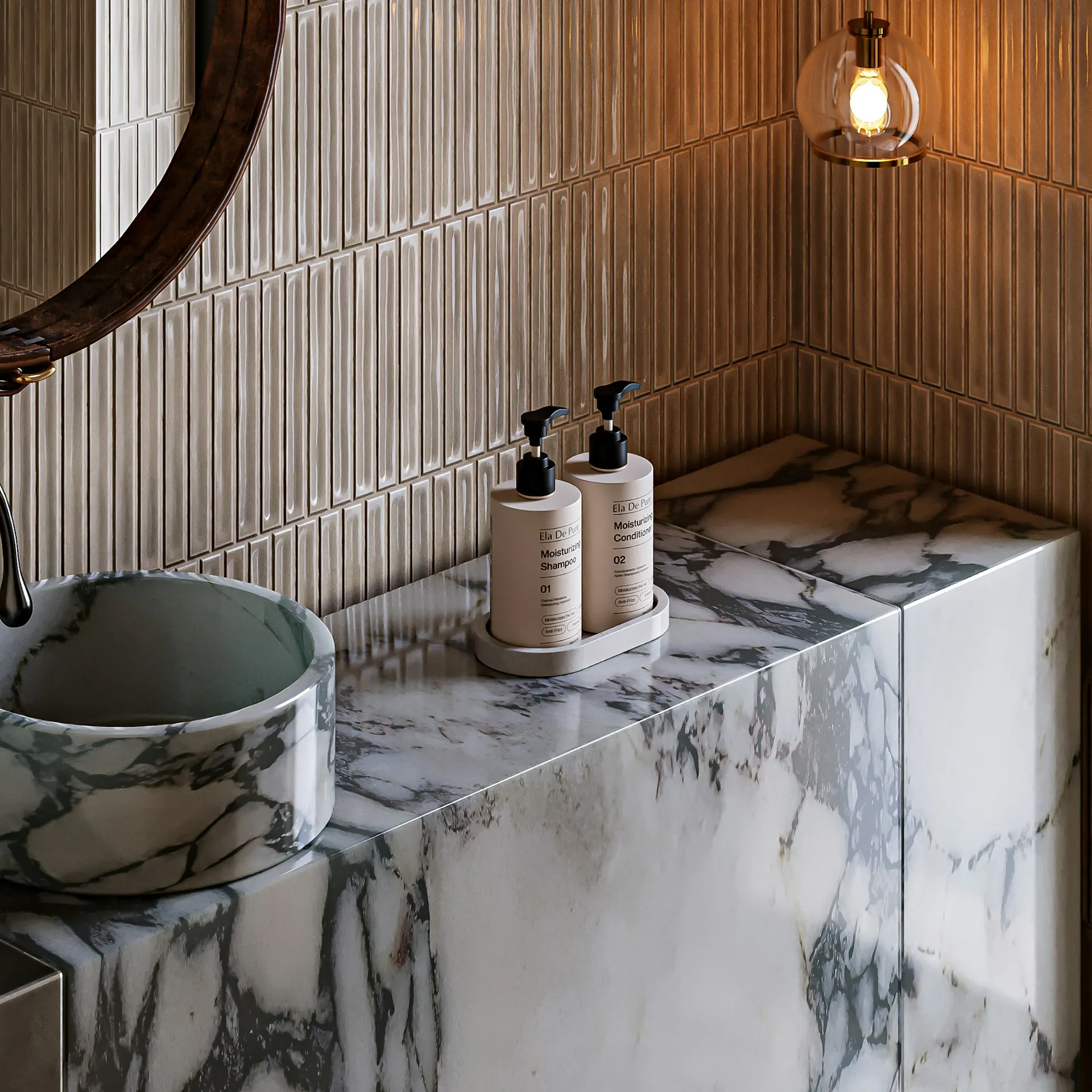
A vessel sink on a 30-inch vanity is a strong powder room moment. The vessel becomes a design feature in the room that visitors actually see.
36 to 48 inch — standard family and primary bathrooms
The 36 to 48 inch tier is the practical standard for family bathrooms and for single-vanity primary bathrooms. The cabinet provides meaningful storage for a daily user; the counter has enough space for a soap dispenser, a toothbrush holder, and a few items left out without becoming cluttered.
A 36-inch vanity fits comfortably between a toilet and a tub or shower in a typical Bergen County family bathroom. A 48-inch vanity fits well in a primary bathroom that does not justify a double; the wider counter and additional drawer space often serve a single primary user better than a forced 60-inch double.
For families with two children sharing a bathroom, a 48-inch single vanity with a generous counter and one large mirror usually works better than a 60-inch double with two cramped sinks.
60 to 72 inch — shared primary and family bathrooms
The 60 to 72 inch tier is where double vanities become practical. The 60-inch dimension is the minimum where two sinks can sit comfortably with usable counter space between them. Below 60 inches, a double becomes a forced compromise.
A 60 to 66 inch double vanity fits comfortably in primary bathrooms shared by two adults who use the bathroom at overlapping times. The two sinks deliver simultaneous use; the trade-off is that each user has less counter space than a wider single would offer.
A 72 inch double vanity fits more comfortably; the two sinks have generous counter space between and beside them. This dimension is the practical sweet spot for most primary bathrooms in Bergen County center-hall colonials and renovated suites.
72 to 84 inch — large primary suites
The 72 to 84 inch tier is the large primary suite range. Two sinks with generous counter space, room for a full storage program, and proportions that match the larger room. Tenafly, Englewood, and renovated Ridgewood and Glen Rock primary suites commonly support this width.
At 84 inches and above, the layout question becomes more open: two sinks with a generous shared counter, or two sinks with a center tower of drawers between them. The center tower trades counter space for vertical storage and creates a stronger visual division between the two stations.
Single vs double — the practical trade-off
The decision between a single and a double vanity comes down to user count, wall length, and daily-use patterns:
Single wins when: the wall length is below 60 inches, only one adult uses the bathroom regularly, the household values counter space over a second sink, or the bathroom is shared by children where one large mirror beats two undersized stations.
Double wins when: the wall length is 60 inches or more, two adults share the bathroom at overlapping times, both adults have meaningful daily-use routines that benefit from a dedicated station, and the budget supports the additional plumbing rough-in for a second drain and supply.
In Hackensack pre-war primary baths, in older Paramus singles, and in compact Fair Lawn split-levels, the single vanity is often the right answer even when the household is two adults. The proportion fits the home’s architectural language better than a forced double.
Depth considerations
Standard vanity depth is around 21 inches. Compact bathrooms sometimes need shallower depth — 18 inches or even 16 inches — to keep the door swing functional and the floor space walkable.
Shallow vanities are usually a custom item; most catalog lines do not offer them. Pre-1970 Bergen County bathrooms occasionally have original plumbing layouts that demand shallow depth, and the custom route is often the only way to fit the room properly.
Floating vs floor-mounted
Floating vanities mount to the wall rather than sitting on the floor. They read lighter visually, simplify floor cleaning, and allow under-cabinet lighting to add an ambient layer. They sacrifice some storage volume to the wall mount and require structural blocking inside the wall.
Floor-mounted vanities feel more grounded and architecturally traditional. They offer more storage volume and simpler installation. In traditional primary baths, floor-mounted is usually the right call; in contemporary bathrooms, floating reads correctly.
When custom is the right answer
Custom vanities make sense when:
- The wall length does not match a catalog width and the gap is large enough to be visible
- The room demands non-standard depth
- The drawer configuration needs to be specific (medication storage, hair tools, deep storage)
- The finish or wood species needs to coordinate with adjacent built-ins
- A floating vanity at a specific dimension is required and catalog lines do not offer it
A local custom program completes a vanity in roughly two weeks for typical configurations. That timing is often faster than many semi-custom catalog vanities.
For the broader vanity buying decision, see how to choose a vanity. For project context, see bathroom remodeling planning. For showroom prep, see the bathroom showroom visit checklist.
When you are ready
When the vanity width and configuration are clear — wall length confirmed, single or double decided, depth reviewed, custom or catalog chosen — the next step is comparing actual vanity samples in person. Continue with Anve Kitchen and Bath in Paramus to see the catalog options at full size and to plan a custom vanity if the room needs one.