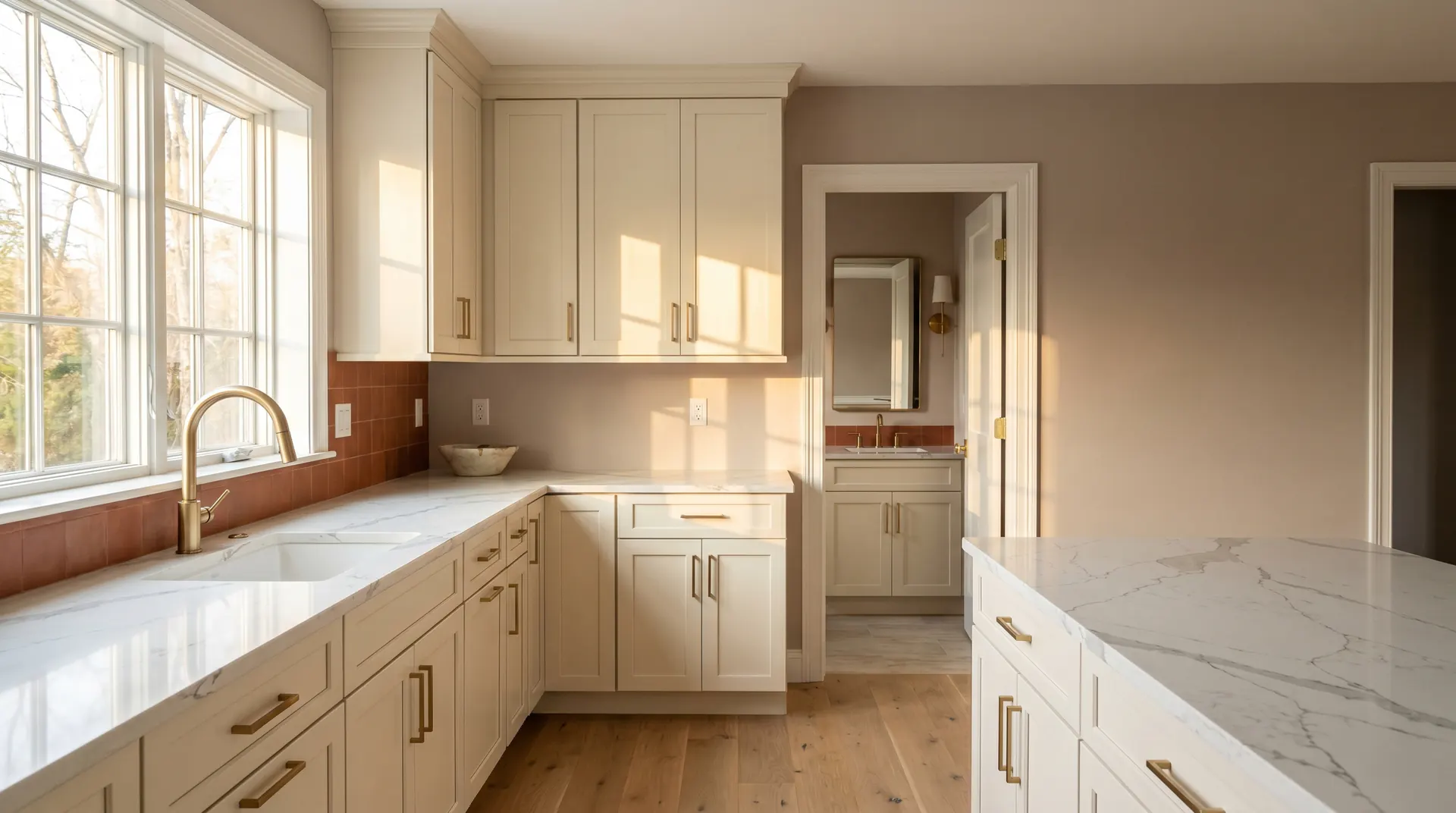
Quartz, natural marble, and sintered stone are the three counter materials most Bergen County homeowners weigh against each other when they renovate a bathroom. Quartz is the low-maintenance default that fits nearly every household and bath type. Natural marble is the design choice that delivers a look nothing else replicates and demands real ongoing care. Sintered stone is the modern premium — denser, scratch-resistant, available in large continuous panels, and priced accordingly. The verdict map below is the short version of the rest of this guide.
This is a comparison guide. If you want a step-by-step buying algorithm, how to choose a bathroom vanity walks the full sequence. If you want sizing and layout direction, bathroom vanity sizes and layouts covers the planning side. This guide narrows the question to the three counter materials that most Bergen County primary and secondary baths are weighing against each other.
The 30-second answer
For most Bergen County homes, quartz is the safer choice, sintered stone is the higher-conviction modern one, and marble is the design-forward one for households that tolerate the maintenance. Quartz fits family baths, secondary baths, primary baths in modestly renovated homes, and any household that wants the counter to disappear into daily routine. Sintered stone fits primary baths in genuinely contemporary renovations and households that want the look of large-format stone without the upkeep. Marble fits primary suites in higher-end homes where the household accepts periodic sealing and lives comfortably with patina.
| Bergen County context | Default verdict |
|---|---|
| Family bath shared with children | Quartz |
| Secondary bath, hall bath, or guest bath | Quartz |
| Primary bath in modestly renovated home | Quartz |
| Primary bath in contemporary renovation | Sintered stone |
| Primary suite in higher-end Tenafly or Englewood home | Sintered stone or marble |
| Powder room as a design moment | Marble or sintered stone |
| Rental or pre-sale refresh | Quartz |
Industry surveys consistently track quartz as the leading bathroom counter material across the U.S. residential market, with engineered surfaces holding the largest share of recent vanity renovations. (2025 U.S. Houzz Bathroom Trends Study)
Quartz — the low-maintenance default
Quartz is an engineered stone composed of roughly 90 to 95 percent ground natural quartz mineral bound with polymer resins and pigments, then formed into slabs at consistent thickness. The result is a non-porous surface that does not require sealing, resists most household stains, and arrives at the showroom in repeatable patterns the homeowner can specify with confidence — what you see in the slab is what you get on the counter.
In Bergen County, quartz fits the housing stock and the household pattern with unusual reliability. A Hackensack pre-war secondary bath, a Paramus single primary bath, a Fair Lawn split-level family bath, a Tenafly powder room, and a Ridgewood guest bath all accept quartz cleanly. The material tolerates the everyday product family that lives on a vanity counter — toothpaste, hand soap, hair products, perfumes, makeup — without the surface logging the visit. It cleans with a soft cloth and a mild soap; it does not etch with acidic products; it does not absorb moisture; it does not require periodic resealing.
The maintenance footprint is genuinely low. The non-porous surface means stains sit on top rather than penetrating, so even slightly delayed cleanup rarely produces a mark. Hard-water spots show on quartz the same way they show on any smooth surface — visible but wipe-clean — and that visibility is closer to glass than to natural stone. Heat tolerance is moderate; the resin component means hot styling tools placed directly on the counter for extended periods can leave a mark. In bathroom use, this rarely matters; a hot curling iron in a heat-safe pouch is the standard precaution.
Where quartz falls short is in the look. Quartz patterns have improved dramatically over the last decade — marble-look quartz with realistic veining is now widely available — but a discerning eye can usually tell quartz from natural marble at close range. For most households this is not a concern. For households that specifically want the irreplaceable depth of natural stone in a primary suite, quartz reads as a careful imitation rather than the original.
Natural marble — the design choice
Marble is a metamorphic natural stone quarried in slabs and finished in either a polished (high-shine) or honed (matte) surface. The look is what marble has been for centuries — depth, veining, character that no engineered material fully replicates. In a primary bath or a powder room treated as a design moment, marble carries a presence quartz and even sintered stone cannot match.
In Bergen County, marble fits higher-end primary suites where the household understands and accepts the maintenance commitment. Tenafly center-hall colonials, Englewood properties, Ridgewood Victorians treated to a thoughtful primary suite renovation, and renovated Cresskill and Alpine homes routinely specify marble in primary baths. The material reads as deliberate design investment, signals craft to the buyer pool at sale, and ages with character when maintained.
The maintenance commitment is real and not optional. Marble is calcium carbonate, which means acidic substances chemically react with the surface and produce etching — a dulled spot where the polish (or hone) has been chemically altered. Bathroom-counter etch sources include certain toothpastes, citrus-based cleaners, perfume sprays, vinegar-containing products, some face washes, and acidic hair products. Etching is not a stain; it cannot be wiped away. Polished marble shows etching most visibly because the dulled spot reads against the high-shine field. Honed marble shows etching less because the matte finish absorbs the dulling; for a marble bath that will see real daily use, honed is usually the better finish.
Sealing is the second part of the commitment. Marble is porous and will absorb pigmented liquids — red wine, dark colored cleaners, hair dye, certain cosmetics — if left in contact for long enough. A quality penetrating sealer applied at install and refreshed periodically (typical guidance is once or twice a year, depending on the product) blocks most of this. Sealing does not prevent etching; etching is a chemical reaction with the surface itself, not an absorption issue. Households that conflate the two often discover the distinction the hard way.
NJ humidity does not damage marble, but it slightly amplifies the maintenance pattern. A polished marble counter in a humid primary bath dries slower after splashes than the same counter in a drier room, which gives standing water more time to deposit minerals or leave a watermark on a less-recently-sealed area. Adequate ventilation, prompt wipe-downs after the daily routine, and disciplined sealing keep the counter looking close to install for years.
Where marble falls short is in households that expect the counter to look exactly the way it did at install ten years later. Marble develops patina; etching accumulates around heavily used zones; small chips can occur at the front edge over time. For households that read this as character, marble is correct. For households that read this as failure, quartz or sintered stone is correct.
Sintered stone — the modern premium
Sintered stone is a manufactured surface produced by compressing natural mineral particles — feldspar, silica, quartz, mineral oxides — under extreme heat and pressure into a fully vitrified slab. Unlike quartz, sintered stone uses no resins or polymer binders; the bond is mineral. The result is a surface that is harder than quartz, more scratch-resistant, more heat-tolerant, more UV-stable, and available in very large continuous panels (up to roughly 126 by 63 inches in standard formats) that allow seamless installs across long counters.
In Bergen County, sintered stone fits primary baths in contemporary renovations and higher-end transitional homes where the household wants the look of large-format premium stone without the maintenance footprint of marble. Renovated Paramus singles with opened floor plans, contemporary builds in Old Tappan and Cresskill, modernized split-levels in Fair Lawn, and primary suites in Tenafly homes pulled in a contemporary direction routinely specify sintered stone. The material also enables seamless integrated sinks — a single material wrapping from counter into basin with no joint — which reads strongly in a contemporary primary bath.
The maintenance footprint is similar to quartz and slightly easier in the corners. The fully vitrified surface is non-porous, requires no sealing, resists staining from common household products, tolerates heat better than quartz (the lack of resins means hot styling tools rarely leave a mark), and shows scratches less readily than any of the three options. UV stability matters less in a bathroom than in a sun-exposed kitchen, but it is part of why sintered stone holds its look in any room over time.
Hard-water visibility is comparable to quartz and slightly more forgiving than polished marble. Mineral spots wipe clean; the surface does not absorb the deposit. NJ humidity has no meaningful effect on the material itself; bathroom ventilation matters for the rest of the room (grout, paint, vanity cabinetry) but not for the counter.
Where sintered stone falls short is in price and fabricator availability. The slabs cost more than quartz or most marble, and the cutting, mitering, and seaming of sintered stone require specialized fabrication that not every Bergen County shop performs at the same level. The fabricator question matters more for sintered stone than for quartz; an excellent quartz fabricator may not be the right choice for a sintered stone install. The showroom step in a bathroom remodel where sintered stone is on the table should include a conversation about which fabricator handles the slab.
Side-by-side comparison
| Dimension | Quartz | Marble | Sintered stone |
|---|---|---|---|
| Surface composition | Engineered: ~90–95% ground quartz + polymer resins | Natural metamorphic stone (calcium carbonate) | Manufactured: mineral particles compressed under heat and pressure, no resins |
| Scratch resistance | High | Moderate (softer than quartz; honed shows scratches less) | Very high (the most scratch-resistant of the three) |
| Etch resistance | High (resin-based, not acid-reactive) | Low (acidic products etch the surface) | Very high |
| Stain resistance | Very high (non-porous) | Moderate (porous; sealing helps but does not eliminate) | Very high (non-porous, fully vitrified) |
| Heat tolerance (context) | Moderate; matters more in kitchens; resin can mark with prolonged direct heat | High; matters more in kitchens | Very high; matters more in kitchens |
| Maintenance footprint | Low. Non-porous, no sealing, mild soap and soft cloth | Higher. Periodic sealing, careful product selection, accepts patina | Low. Non-porous, no sealing, mild soap and soft cloth |
| Lifespan | Decades with normal use | Decades with maintenance; develops patina | Decades with normal use; very low cosmetic wear |
| NJ humidity behavior | Unaffected by humidity | Unaffected by humidity directly; slow drying amplifies water-spot patterns on unsealed areas | Unaffected by humidity |
| Hard-water mark visibility | Visible, wipe-clean, comparable to glass | More visible on polished; less on honed; can leave deposits if not addressed | Visible, wipe-clean, comparable to quartz |
| Price tier | Mid (broadest range) | Mid to high (varies by stone variety; rare cuts run premium) | High (premium tier) |
| Fabricator availability in Bergen County | Broad; most fabricators handle quartz well | Broad; experienced stone fabricators standard in the area | Narrower; specialized fabrication required |
| Resale signal | Broad, neutral, recognized as low-maintenance | Design-forward in higher-end suites; can read as maintenance liability in mid-market | Premium and contemporary; signals recent renovation |
Which fits which Bergen County bathroom
The counter decision starts with the bathroom and the household. The summary below maps the three materials against the most common Bergen County primary and secondary bath contexts.
Family bath shared with children. Quartz. The non-porous surface, the indifference to acidic toothpastes and hair products, and the absence of a sealing routine fit a household that does not want the counter to be a project. Marble in a kid-shared bath etches early and frequently; the maintenance commitment does not match the use pattern.
Secondary, hall, or guest bath. Quartz. The same logic applies in lower-traffic rooms where the household is unlikely to commit attention to sealing and product discipline for a counter that gets used a few times a week.
Primary bath in a modestly renovated home. Quartz, with the option of a marble-look quartz pattern if the household wants the visual without the upkeep. Sintered stone is also possible if the budget supports it and the rest of the bath reads premium.
Primary bath in a contemporary renovation. Sintered stone is often the strongest answer. The large-format slabs, the option of a seamless integrated sink in the same material, and the durability profile fit the design language. Quartz works as the value-tier option; marble can read as a deliberate textural counterpoint to an otherwise sleek room.
Primary suite in a higher-end Tenafly or Englewood home. Marble or sintered stone. Marble carries the design pedigree and the patina; sintered stone carries the contemporary cleanness. Either reads correctly. The household’s tolerance for sealing and product discipline is the deciding factor.
Powder room as a design moment. Marble or sintered stone. Powder rooms see low daily use and high visitor visibility; the maintenance commitment of marble is more tolerable in a low-use room, and the visual payoff is high. A bookmatched marble slab on a small powder-room counter reads strongly.
Rental or pre-sale refresh. Quartz. Maximum buyer recognition, minimum maintenance liability, broadest acceptance.
For deeper coverage of vanity selection and sizing alongside the counter decision, see how to choose a bathroom vanity and bathroom vanity sizes and layouts.
Maintenance reality check — NJ humidity and hard water
Two regional factors deserve a clear-eyed look before specifying any of the three materials in a Bergen County bathroom.
NJ humidity. Summer humidity in Bergen County frequently runs above 70 percent, and primary baths used after morning showers carry elevated humidity for extended periods. Humidity does not damage any of the three counter materials, but it slows the drying of standing water. On polished marble that has not been sealed recently, slower drying means mineral deposits and watermarks have more time to settle in. On quartz and sintered stone, slower drying means a slightly more visible water spot on the counter until it is wiped — cosmetic, not material. Adequate bath ventilation (a properly sized exhaust fan ducted to the exterior, run during and after showers) is the single most useful intervention.
Hard water. Bergen County water hardness varies by municipality but consistently sits in the moderately hard to hard range. The result is mineral deposits on glass, fixtures, and counters wherever water sits. On all three materials, the deposit reads as a visible spot until cleaned. On marble, the deposit can also begin to bond with the porous surface if left for long periods on unsealed areas — sealing reduces this dramatically. On quartz and sintered stone, the deposit always wipes clean with a mild cleaner. A faucet aerator change to a flow-restricting model reduces splash and is a low-effort intervention.
The honest commitment level. Quartz and sintered stone are wipe-down counters. The household sees them, wipes them, and moves on. Marble is a wipe-down counter plus a sealing schedule plus a product-selection awareness. Households that resent the latter two will resent the marble within the first year. Households that read the maintenance as part of living with a beautiful natural material will not. Be honest about which household yours is before specifying.
Anti-patterns to avoid
A few counter decisions that consistently produce regret in Bergen County bathrooms when the homeowner is choosing between quartz, marble, and sintered stone:
- Specifying polished marble in a kid-shared family bath because the design images on a planning site looked clean — the counter will etch within months and read as failure rather than patina
- Choosing marble without committing to a sealing schedule and a product-discipline pattern — the maintenance commitment is part of the material, not a separate optional add-on
- Specifying sintered stone without confirming a fabricator who handles the slab competently — the install is where premium materials succeed or fail
- Picking quartz patterns that imitate dramatic natural marble veining without seeing a full-size slab — small samples mislead on movement and color saturation at counter scale
- Letting price drive the decision in a primary suite where the household genuinely wants marble — quartz marble-look will read as the imitation it is in a room that otherwise carries craft
- Specifying marble in a rental or pre-sale refresh — buyers read marble as a maintenance liability in a mid-market bath and will discount accordingly
- Choosing the counter material before walking the bathroom with a designer and considering the rest of the room (tile palette, vanity finish, hardware family, lighting)
For broader project context around the bathroom remodel where the counter sits, see tile ideas for kitchens and bathrooms for tile coordination, how to choose a bathroom vanity for vanity selection, and bathroom vanity sizes and layouts for layout direction.
When you are ready
Quartz, marble, and sintered stone resolve quickly once the bath type, household maintenance tolerance, renovation scope, and budget are honest. Most Bergen County bathrooms land on quartz; a meaningful share of contemporary primary baths land on sintered stone; a smaller share of higher-end primary suites and powder rooms land on marble. The next step is comparing actual slab samples in person — color, movement, finish, the way each material reads under bathroom lighting and against the vanity finish. Continue with Anve Kitchen and Bath in Paramus to see the three material families side by side at full size.